

Dental Education & Cosmetic Insights in Richmond TX
Our dental blog shares expert insights on Invisalign, smile makeovers, veneers, and preventive care for patients in Richmond TX and throughout Fort Bend County. We believe informed patients make confident decisions about their oral health.
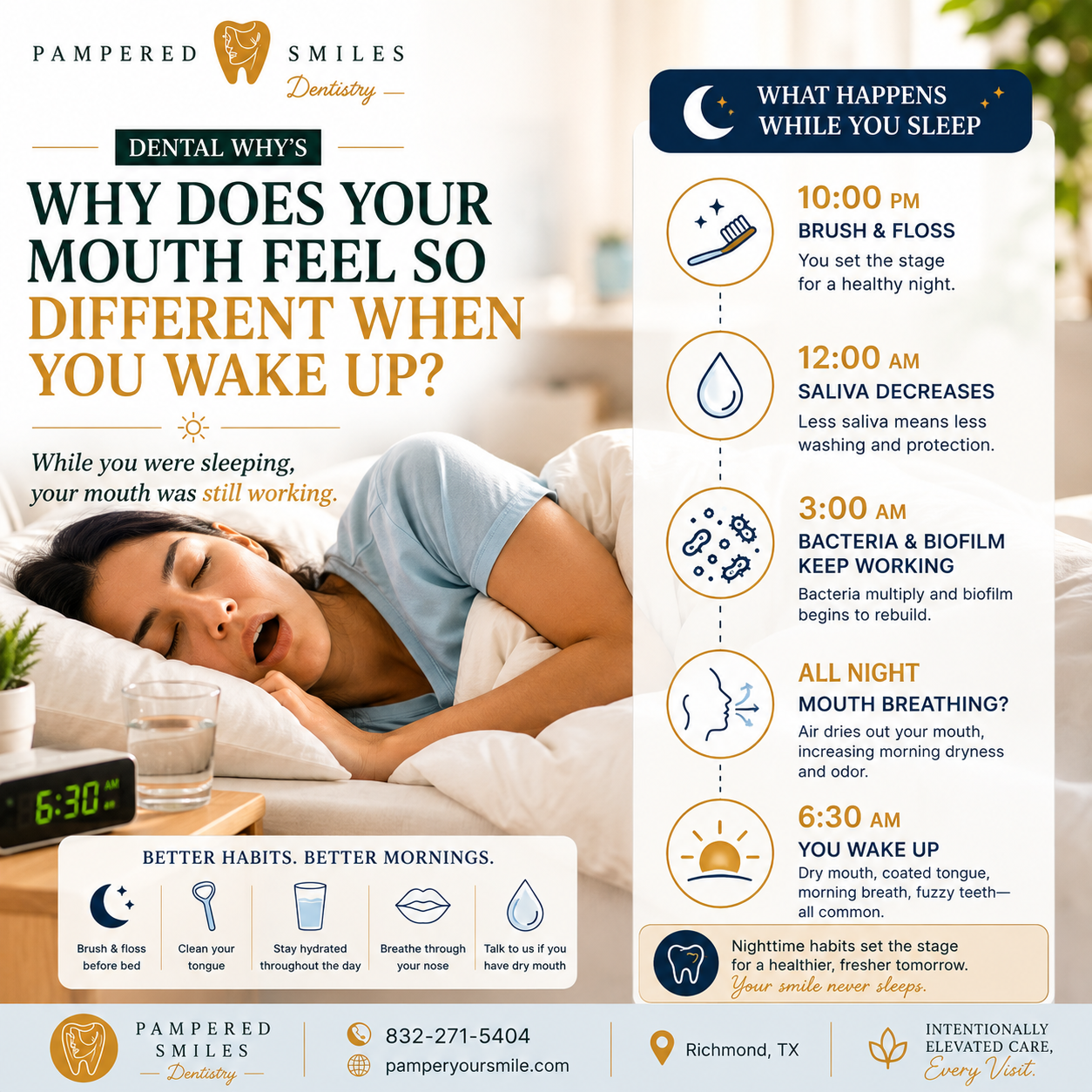
Dental Why's: Why Does Your Mouth Feel So Different When You Wake Up?
You brush before bed, go to sleep with a clean mouth—and wake up feeling like something changed overnight. It did. While you sleep, saliva production decreases and your oral environment changes in ways you can actually feel when you wake up.
What Really Happens to Your Teeth, Saliva, and Bacteria While You Sleep
You brush your teeth before bed.
Maybe you floss.
Your mouth feels fresh.
Your teeth feel smooth.
Then you go to sleep.
Eight hours later...
Your mouth may feel like an entirely different place.
Your breath isn't exactly fresh.
Your teeth may feel coated.
Your tongue feels different.
And sometimes your mouth feels downright dry.
What happened?
You weren't eating.
You weren't drinking soda.
You weren't snacking.
You were literally doing nothing.
Here's the Dental Why's:
Why does your mouth feel so different when you wake up?
Because while you were sleeping...
your mouth wasn't.
Your Mouth Has a Night Shift
Your mouth is an active biological environment 24 hours a day.
Even while you're sleeping, bacteria are present.
Your oral tissues are functioning.
Your teeth are interacting with saliva.
And your body is regulating the environment around them.
But one major thing changes when you fall asleep.
Your saliva slows down.
And that changes almost everything.
Saliva Is Doing More Than Keeping Your Mouth Wet
Most of us don't appreciate saliva until we don't have enough of it.
During the day, saliva is constantly helping your mouth.
It:
Washes away food particles
Helps neutralize acids
Lubricates your tissues
Helps you swallow
Provides minerals involved in maintaining enamel
Helps control the oral environment
Think of saliva as part of your mouth's natural maintenance system.
During sleep, however, salivary flow normally decreases.
So the environment changes.
The Cleaning Crew Gets Smaller at Night
Imagine a busy building that's cleaned throughout the day.
People make messes.
The cleaning staff continuously works behind them.
Now imagine most of the cleaning staff leaves overnight.
The building doesn't suddenly become filthy.
But things begin accumulating more easily.
Something similar happens in your mouth.
With less saliva flowing, bacteria and their byproducts aren't being cleared away as efficiently.
That's one reason your mouth may feel coated or sticky when you wake up.
And That's Where Morning Breath Comes From
Yes.
We're going there.
Morning breath.
While you sleep, bacteria continue breaking down proteins and other materials in your mouth.
Some bacteria produce compounds containing sulfur.
These volatile sulfur compounds contribute to the odor we associate with bad breath.
With less saliva available to wash things away, those compounds can become more noticeable.
So morning breath isn't necessarily evidence that something terrible happened overnight.
It's partly the result of your nighttime oral environment.
Your Tongue Plays a Bigger Role Than You Think
Look closely at your tongue.
It isn't smooth.
Its textured surface contains countless tiny areas where bacteria, dead cells, and debris can accumulate.
That's one reason the tongue can contribute significantly to bad breath.
For some patients, gently cleaning the tongue as part of their oral hygiene routine can make a noticeable difference.
Your teeth aren't the only surfaces in your mouth that need attention.
Mouth Breathing Can Make Everything More Noticeable
Now imagine you're already producing less saliva...
and then you're breathing through your mouth for several hours.
Air continuously passes over the tissues.
The mouth can become even drier.
People who sleep with their mouths open may wake up with:
A very dry mouth
Sticky saliva
A dry tongue
Stronger morning breath
Dry lips or throat
Occasional mouth breathing may happen when you're congested.
But persistent nighttime mouth breathing can have several causes and is worth mentioning to your healthcare providers.
Why Does Dry Mouth Matter to Your Teeth?
Dry mouth isn't simply uncomfortable.
Saliva is part of your natural defense against tooth decay.
When salivary flow is significantly reduced, acids aren't neutralized as effectively and food particles and bacteria aren't cleared as efficiently.
Over time, persistent dry mouth can increase the risk of:
Cavities
Gum problems
Bad breath
Oral irritation
Difficulty chewing or swallowing
That's why we pay attention when patients tell us:
"My mouth always feels dry."
It's not a trivial complaint.
Your Medications May Be Part of the Story
One of the most common contributors to dry mouth is medication.
Many prescription and over-the-counter medications can reduce salivary flow or make the mouth feel dry.
That means a change in medication can sometimes create a change in your oral health.
This is another reason we ask about your medications at dental appointments.
What happens elsewhere in your body can change the environment around your teeth.
What About That Coating on Your Teeth?
Remember our first September Dental Why's?
Plaque doesn't take the night off either.
Biofilm begins developing again after you brush.
While you're asleep, bacteria continue interacting with your tooth surfaces.
That's one reason your teeth may not feel exactly as smooth when you wake up as they did immediately after brushing.
Your mouth is constantly rebuilding its microbial environment.
This Is Why Brushing Before Bed Matters So Much
Now think about what happens if you don't brush before bed.
You're entering a period of reduced salivary flow with:
Food debris still present
Mature plaque still on your teeth
Sugars or carbohydrates remaining in the mouth
That's not the environment we want sitting undisturbed for hours.
Brushing before bed helps reduce the amount of plaque and debris present before your mouth enters its nighttime state.
Your nighttime brushing routine isn't just about fresh breath.
It's about changing the starting conditions for the next eight hours.
Should You Brush Before or After Breakfast?
This is where patients often ask:
"So should I brush as soon as I wake up—or after breakfast?"
Either approach can fit into a good routine, but there are some considerations.
Brushing when you wake up removes accumulated plaque and freshens your mouth before breakfast.
If you prefer brushing after breakfast, be mindful after consuming acidic foods or beverages. Giving saliva some time to neutralize the acidic environment before brushing can help avoid brushing softened enamel immediately after an acid exposure.
The bigger priority?
Brush thoroughly twice a day with fluoride toothpaste and clean between your teeth daily.
Consistency matters more than creating a perfect morning ritual.
When Morning Dryness Isn't Just "Morning Mouth"
Occasional morning dryness is common.
But if you regularly wake up with an extremely dry mouth—or feel dry throughout the day—tell us.
Persistent dry mouth may be associated with medications, dehydration, mouth breathing, certain medical conditions, or other factors.
Sometimes the most useful dental information comes from something a patient almost didn't mention.
The Bigger Dental Why's
Why does your mouth feel so different when you wake up?
Because sleep changes the environment inside it.
Your saliva slows down.
Bacteria continue working.
Biofilm continues developing.
Your tongue accumulates debris.
And if you breathe through your mouth, the environment may become even drier.
While you sleep, your mouth doesn't simply turn off.
It enters a different biological mode.
That's why what you do before you close your eyes matters.
Brush.
Clean between your teeth.
Give your mouth the best possible starting point for its night shift.
Because even while you're resting...
your smile is still at work.
People Also Ask
Why is my mouth so dry when I wake up?
Salivary flow naturally decreases during sleep. Mouth breathing, dehydration, medications, and certain health conditions can make morning dryness more noticeable.
Why does my breath smell bad in the morning?
Reduced saliva allows bacterial byproducts, including volatile sulfur compounds, to accumulate more easily overnight.
Why do my teeth feel coated when I wake up?
Dental biofilm continually reforms after brushing. Reduced salivary flow overnight can also make your mouth feel stickier or more coated.
Is morning dry mouth bad for your teeth?
Occasional dryness isn't necessarily concerning, but persistent dry mouth can increase cavity risk because saliva plays an important role in protecting teeth.
Frequently Asked Questions
-
For many people, gently brushing or cleaning the tongue can help remove accumulated debris and bacteria associated with bad breath.
-
Persistent mouth breathing can contribute to oral dryness. If it happens regularly, particularly alongside snoring or other sleep-related concerns, discuss it with an appropriate healthcare professional.
-
Yes. Many medications can contribute to dry mouth, which is one reason keeping your dentist updated about your medications matters.
-
Water can relieve the sensation temporarily and helps with hydration, but persistent reduced salivary flow may require addressing the underlying cause.
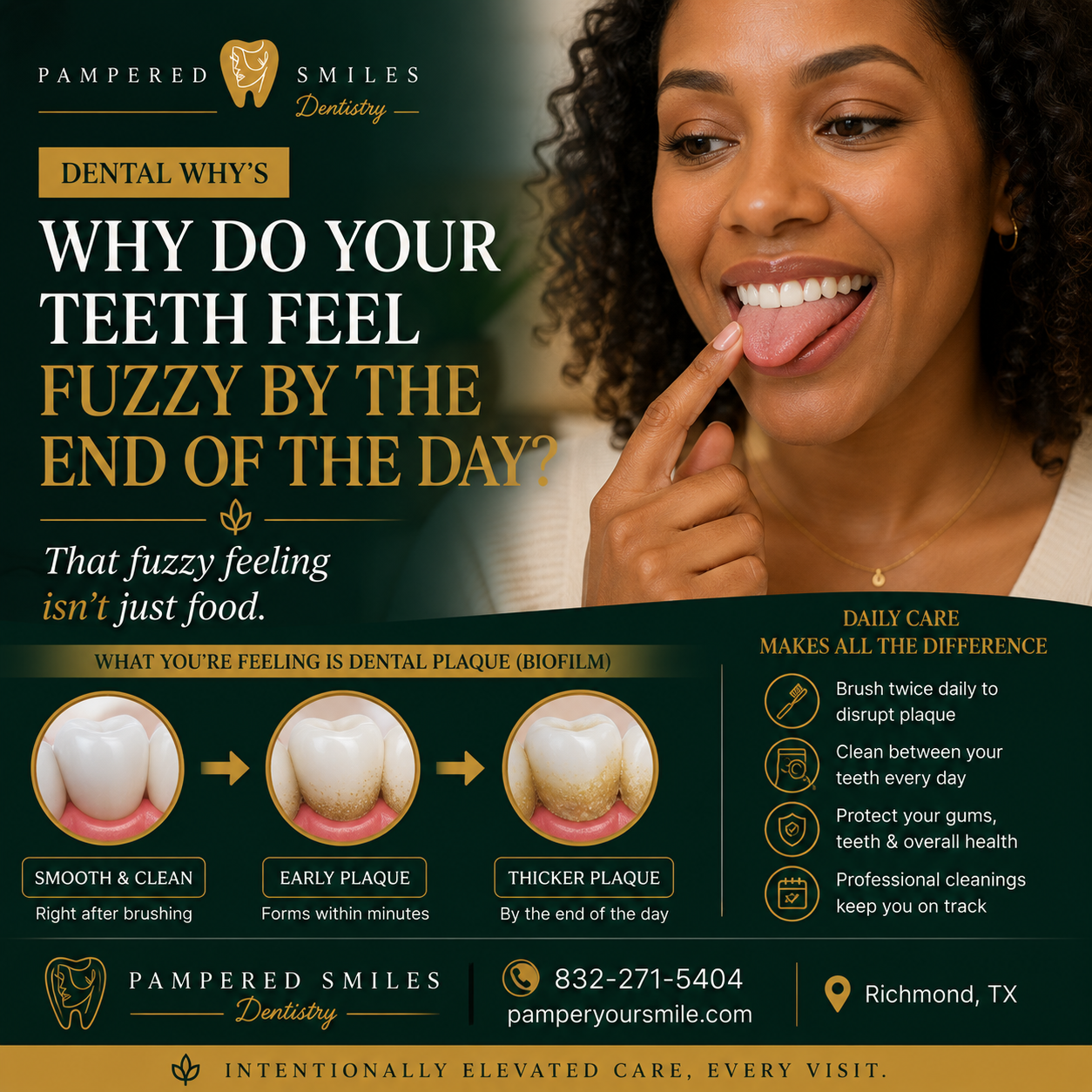
Dental Why's: Why Do Your Teeth Feel Fuzzy by the End of the Day?
Run your tongue across your teeth in the morning and they may feel smooth. By the end of the day, they can feel completely different. That fuzzy coating isn't simply leftover food—it's dental plaque, a complex bacterial biofilm that continually forms on your teeth.
That Fuzzy Feeling Isn't Just Food—It's a Living Biofilm Forming on Your Teeth
Try something.
Right after brushing your teeth, run your tongue across the front of them.
Smooth.
Clean.
Almost polished.
Now do the same thing late in the afternoon or just before bed.
They may feel completely different.
Fuzzy.
Rough.
Maybe even slightly sticky.
Most of us have experienced it.
But what exactly are you feeling?
Here's the Dental Why's:
Why do your teeth feel fuzzy by the end of the day?
Because the moment you finish brushing, your mouth begins rebuilding something on the surface of your teeth.
And it's much more interesting than leftover food.
Your Teeth Are Never Really "Bare"
Within minutes after cleaning your teeth, proteins and other components from your saliva begin coating the enamel.
This microscopic layer is called the acquired pellicle.
You can't see it.
You probably can't feel it.
And the pellicle itself isn't necessarily a bad thing. It can actually help protect enamel from acids and normal wear.
But it also creates a surface where bacteria can attach.
And that's where the story gets interesting.
Bacteria Begin Moving In
Your mouth naturally contains hundreds of species of microorganisms.
That's normal.
After the pellicle forms, certain bacteria begin attaching themselves to it.
Then other bacteria attach to those bacteria.
They multiply.
They interact.
And eventually they create an organized community on the surface of your teeth.
Dentists call this dental plaque.
Scientists often describe it more specifically as a biofilm.
Plaque Isn't Just "Dirt"
This is one of the most important distinctions.
Plaque isn't simply food debris sitting on your teeth.
A biofilm is an organized community of microorganisms living together within a protective matrix.
Think about the slippery coating that can develop on a rock in a stream.
Or the film that forms inside a water bottle that hasn't been cleaned thoroughly.
Biofilms are remarkably good at attaching themselves to surfaces.
And your teeth provide something unusual inside the human body:
a hard surface that doesn't shed.
Your skin constantly sheds cells.
The lining of your mouth continually renews itself.
But your enamel stays put.
That gives bacteria an ideal surface on which to establish themselves.
So Why Can You Feel It?
As plaque accumulates and becomes thicker, the surface of your teeth becomes less smooth.
Your tongue is incredibly sensitive to texture.
That's why you can detect:
A tiny piece of food
A chipped tooth
A rough filling
A small change in your bite
And it's why your tongue can recognize when that smooth enamel surface has developed a layer of plaque.
That "fuzzy" feeling is essentially your tongue detecting a change in the surface texture of your teeth.
Brushing Doesn't Sterilize Your Mouth
And it shouldn't.
Your mouth has a complex microbiome containing organisms that normally live there.
The goal of brushing isn't to eliminate every bacterium.
That's impossible.
Instead, brushing disrupts the biofilm before it becomes mature and harmful.
Think of it like breaking up a neighborhood before it becomes a city.
Every time you brush effectively, you're disrupting the bacterial community and forcing it to start rebuilding.
But Your Toothbrush Can't Reach Everywhere
Here's where flossing becomes important.
A toothbrush cleans the outer, inner, and chewing surfaces of your teeth very well.
But neighboring teeth touch each other.
The bristles can't reliably clean those tight spaces.
Biofilm still develops there.
That's why cleaning between your teeth matters even when your teeth look perfectly clean from the outside.
The places you can't easily see are often exactly where plaque has an opportunity to remain undisturbed.
What Happens If Plaque Stays Too Long?
When plaque isn't regularly removed, several things can happen.
Certain bacteria within the biofilm metabolize sugars and produce acids.
Those acids can gradually remove minerals from enamel and contribute to cavities.
At the gumline, bacterial biofilm can trigger inflammation.
Your gums may become:
Red
Puffy
Tender
More likely to bleed
And if plaque remains long enough, minerals in saliva can harden portions of it into calculus, commonly called tartar.
Once calculus forms, brushing alone can't remove it.
That's one reason professional dental cleanings are necessary even for people who brush every day.
Why Do Some People Get More Plaque Than Others?
You've probably noticed that some people seem to develop that fuzzy feeling faster than others.
Several things can influence plaque accumulation, including:
Saliva composition
Tooth position
Crowded teeth
Dry mouth
Diet
Oral hygiene habits
Dental restorations
How frequently plaque is disrupted
This is why two people with similar brushing routines may not have identical oral health.
Every mouth has its own environment.
The Bigger Dental Why's
Why do your teeth feel fuzzy by the end of the day?
Because your mouth is alive.
Even immediately after brushing, your oral environment begins rebuilding itself.
Saliva coats your teeth.
Bacteria attach.
Communities form.
Biofilm develops.
And then your toothbrush comes along and disrupts the whole process.
Only for it to begin again.
That's why oral hygiene isn't something you "finish."
It's maintenance.
Your toothbrush isn't just cleaning your teeth. It's interrupting biology.
And doing that consistently is one of the simplest ways to protect your smile for a lifetime.
People Also Ask
Why do my teeth feel fuzzy even after brushing?
If teeth still feel fuzzy immediately after brushing, plaque may not have been completely removed. Brushing technique, crowded teeth, dental restorations, or hardened calculus may also contribute to roughness.
Is the fuzzy feeling on my teeth plaque?
Often, yes. Plaque buildup can make otherwise smooth enamel feel fuzzy or rough to the tongue. However, persistent roughness in one specific area may have another cause and should be evaluated.
How quickly does plaque form after brushing?
The salivary pellicle begins forming very soon after the tooth surface is cleaned, followed by bacterial attachment and progressive biofilm development.
Does mouthwash remove plaque?
Mouthwash can complement brushing and interdental cleaning, but it generally doesn't replace the mechanical disruption of plaque with a toothbrush and floss or another interdental cleaner.
Frequently Asked Questions
-
Plaque is a soft bacterial biofilm that can generally be disrupted with effective home care. Tartar, or calculus, is mineralized plaque that has hardened onto the teeth and requires professional removal.
-
Yes. Bacteria in oral biofilms can contribute to compounds associated with bad breath.
-
Plaque and calculus commonly accumulate around the gumline, although roughness can have other causes. Your dentist or hygienist can determine what you're feeling.
-
Clean enamel generally feels smooth, but restorations, natural tooth anatomy, calculus, chips, or other changes can alter the texture. A new or persistent rough area deserves evaluation.
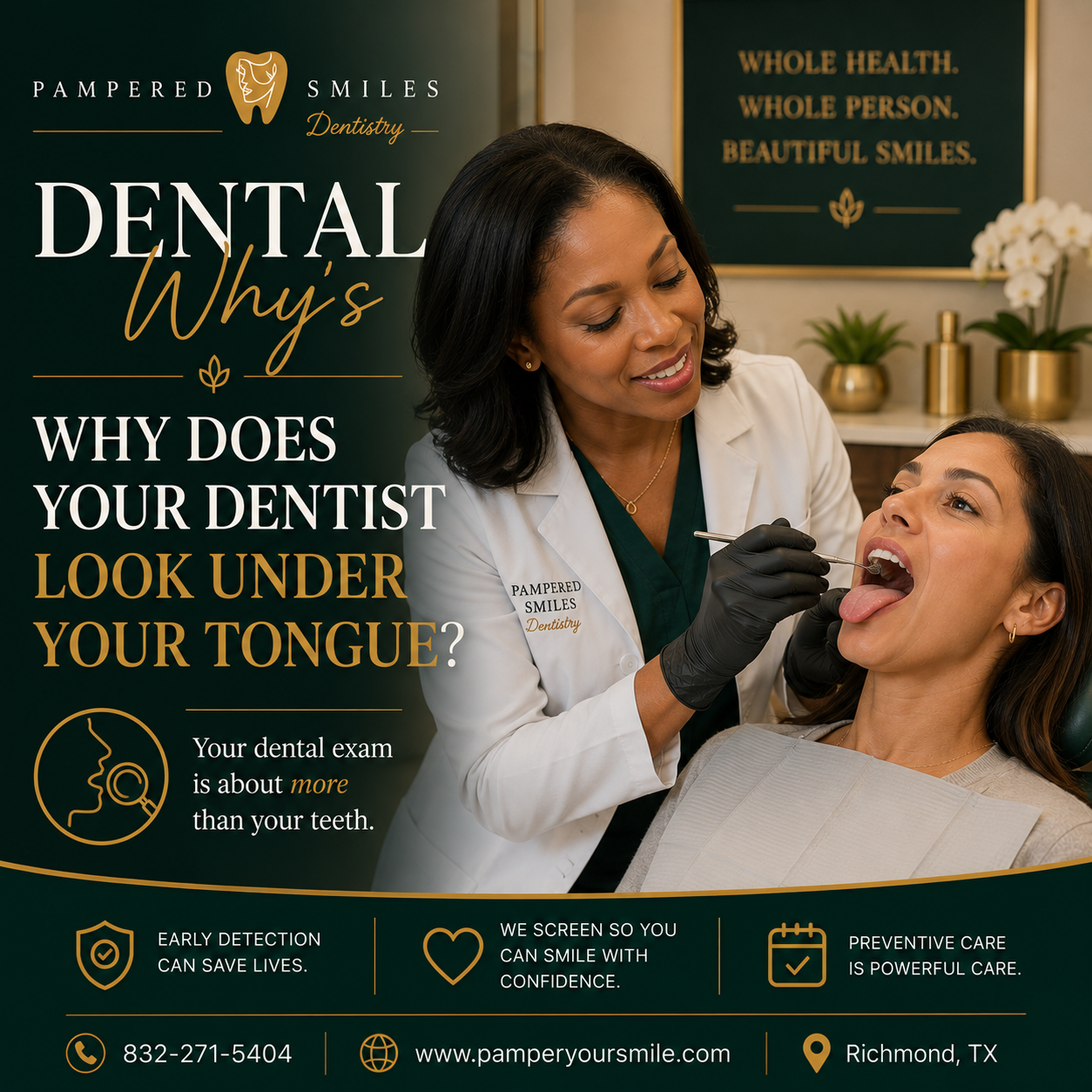
Dental Why's: Why Does Your Dentist Look Under Your Tongue?
Your dentist isn't just checking your teeth. That quick look under your tongue, along your cheeks, and around your mouth is part of an important screening for abnormal tissue—including signs that could indicate oral cancer.
The Oral Cancer Screening Happening During Your Dental Exam That You May Not Even Notice
Why Does Your Dentist Look Under Your Tongue?
You're sitting in the dental chair expecting us to look at your teeth.
Then something interesting happens.
We ask you to stick out your tongue.
We move it from side to side.
We look underneath it.
We examine your cheeks, lips, gums, and the roof of your mouth.
Sometimes we even feel along your jaw and neck.
And you may be thinking:
"I thought we were checking my teeth."
We are.
But we're also checking something much bigger.
Here's the Dental Why's:
Why does your dentist look under your tongue?
Because some of the most important things we look for during a dental exam have absolutely nothing to do with cavities.
We're also examining the tissues of your mouth for abnormalities—including signs that could warrant further evaluation for oral cancer.
Your Mouth Is More Than Teeth
Your teeth may get most of the attention, but they're only part of your oral health.
Your mouth also includes your:
Lips
Tongue
Gums
Cheeks
Palate
Floor of the mouth
Throat and surrounding tissues
During a comprehensive dental exam, we're paying attention to all of them.
We're looking for changes in color, texture, symmetry, swelling, sores, lumps, or areas that simply don't look the way healthy tissue normally should.
Why Under the Tongue?
The underside of your tongue and the floor of your mouth are particularly important areas to examine.
They're also areas most people rarely look at themselves.
Changes there may be painless and easy to overlook.
That's one reason your dentist may gently move your tongue during an examination or ask you to lift it toward the roof of your mouth.
We're looking where you probably aren't.
What Are We Looking For?
Most changes we see in the mouth are not cancer.
A sore may come from biting your cheek.
A rough area may come from a sharp tooth.
An ulcer may heal on its own.
But certain changes deserve closer attention.
These can include:
A sore that doesn't heal
Red or white patches
Unexplained lumps or thickened areas
Persistent hoarseness
Difficulty swallowing
Unexplained numbness
Changes in how your tongue moves
Finding something unusual doesn't automatically mean something serious is wrong.
It means it deserves attention.
Oral Cancer Doesn't Always Hurt
This is one of the most important Dental Why's.
We often associate serious problems with pain.
But early oral cancer may not hurt.
There may be no dramatic symptom telling you something is wrong.
That's why visual and physical examinations matter.
We don't want to wait for pain to tell us to start looking.
Who Is at Risk?
Tobacco and heavy alcohol use are established risk factors for cancers of the mouth and throat.
But they aren't the whole story.
Certain types of human papillomavirus (HPV), particularly HPV-16, are associated with many cancers of the oropharynx—the area farther back in the throat that includes the tonsils and base of the tongue.
Age and cumulative exposure to risk factors can matter as well.
And importantly, oral and oropharyngeal cancers can occur in people who don't fit the traditional risk profile.
That's why screening isn't reserved only for people we consider "high risk."
A Dental Cleaning Is About More Than Clean Teeth
This is one reason we encourage routine preventive visits even when your teeth feel perfectly fine.
You may come in thinking:
"I'm just here for my cleaning."
But your dental team is evaluating much more.
Your gums.
Your bite.
Your existing dental work.
Changes in your teeth.
Changes in your soft tissues.
And areas of your mouth you may never examine yourself.
Sometimes prevention means finding a cavity while it's small.
Sometimes it means noticing something that isn't a dental problem at all.
What Happens If We Find Something?
An unusual area doesn't automatically mean cancer.
Depending on what we see, we may document it and monitor it, remove a source of irritation, recheck the area after a short period, or recommend evaluation by an appropriate specialist.
The important thing is that it was noticed.
Because when something in your mouth changes, ignoring it doesn't provide an answer.
Evaluating it does.
The Bigger Dental Why's
Why does your dentist look under your tongue?
Because dentistry isn't only about saving teeth.
It's about caring for the person those teeth belong to.
Sometimes one of the most valuable things we can do during your appointment takes only a few moments.
Look.
Feel.
Notice.
And ask questions when something has changed.
Your routine dental exam may feel ordinary.
But the things we're looking for can be anything but.
That's intentionally elevated care.
People Also Ask
Why does my dentist check underneath my tongue?
The floor of the mouth and underside of the tongue are important areas to examine for sores, abnormal tissue, lumps, color changes, and other findings that may require further evaluation.
What does oral cancer look like?
Possible warning signs can include persistent sores, red or white patches, lumps, thickened tissue, unexplained numbness, or difficulty swallowing. These symptoms can have many non-cancerous causes, so they require professional evaluation rather than self-diagnosis.
Does oral cancer hurt?
Not necessarily. Early abnormalities may be painless, which is one reason routine examinations are important.
Can someone who doesn't smoke develop oral cancer?
Yes. Tobacco is an important risk factor, but oral and oropharyngeal cancers can occur in people who have never smoked.
Frequently Asked Questions
-
A routine visual and physical examination of the mouth is generally quick and noninvasive.
-
Your dentist can recommend an examination schedule based on your individual health and risk factors. Oral soft tissues are commonly evaluated as part of routine dental examinations.
-
Yes. A sore or unexplained change that persists—particularly for around two weeks or longer—should be professionally evaluated.
-
Your dentist may monitor the area, schedule a follow-up examination, or refer you to an appropriate specialist for further evaluation. A biopsy is required to definitively diagnose cancer.
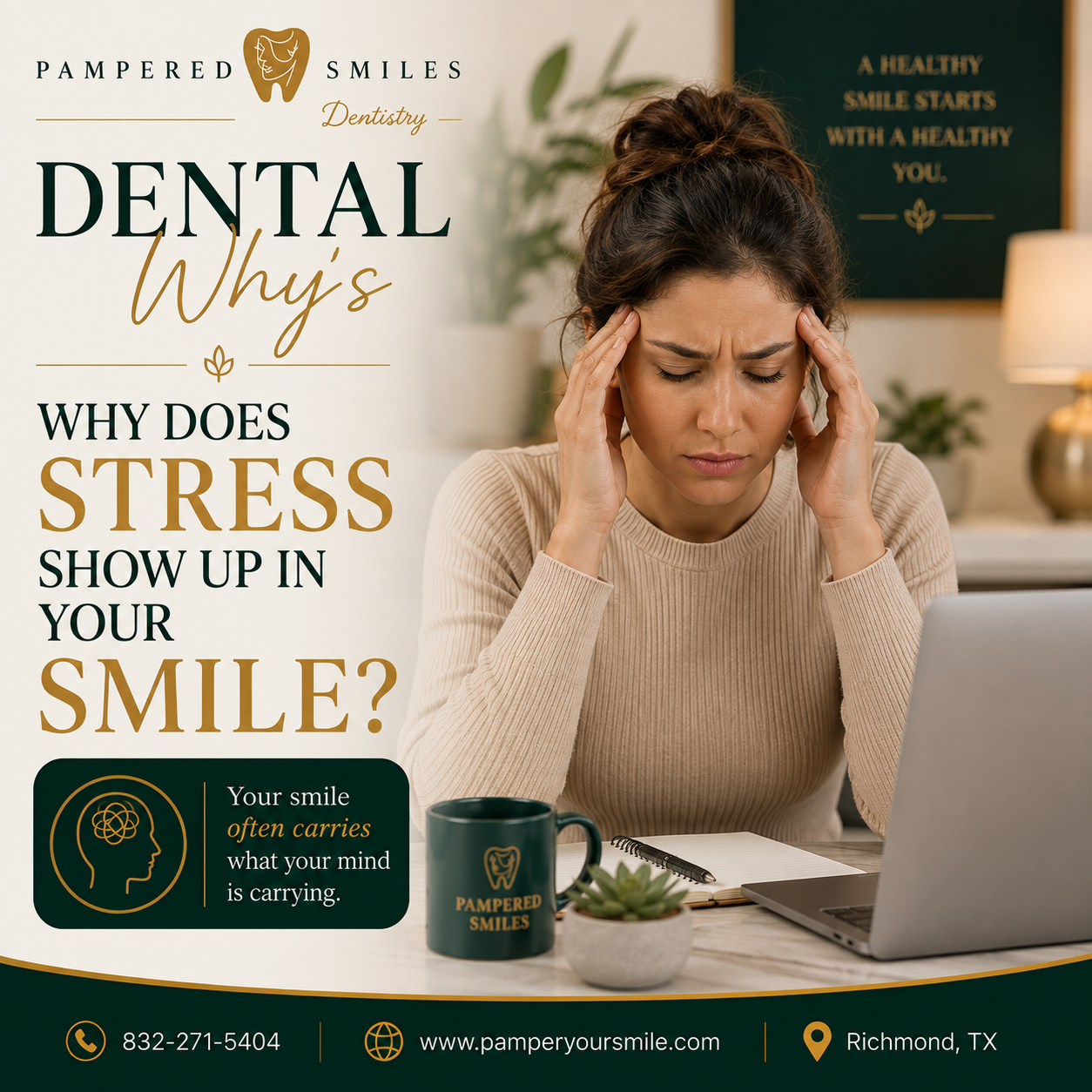
Dental Why's: Why Does Stress Show Up in Your Smile?
Stress doesn't stay in your mind. It often shows up in your smile first. Learn why stress can cause jaw pain, teeth grinding, cracked teeth, and dry mouth—and how to protect your smile.
What Your Teeth, Jaw, and Gums Can Reveal About the Pressure You're Under
Why Does Stress Show Up in Your Smile?
You can feel stress in your shoulders.
You can feel it in your neck.
You may even feel it in your stomach.
But one of the first places stress often appears is somewhere many people never expect...
Your mouth.
Here's the Dental Why's:
Why does stress show up in your smile?
Because your mouth is closely connected to your muscles, nervous system, and daily habits.
When your body carries stress, your smile often carries it too.
Your Jaw Muscles Never Really Get a Day Off
Every day your jaw performs thousands of small movements.
Talking.
Chewing.
Swallowing.
Yawning.
When stress increases, those muscles often stay tense even when you're not eating or speaking.
Many people unknowingly clench their teeth while concentrating, driving, exercising, or sleeping.
Over time, those extra forces begin affecting your teeth and jaw.
Grinding Often Happens While You Sleep
One of the most common effects of stress is nighttime grinding, also called bruxism.
Many people don't realize they grind until someone else hears it—or until their dentist notices the signs.
Grinding can lead to:
Flattened teeth
Chipped enamel
Cracked teeth
Tooth sensitivity
Headaches
Jaw soreness
Sometimes the damage develops long before pain appears.
Stress Can Change Your Saliva Too
Stress doesn't only affect your muscles.
It can also reduce saliva production.
Saliva protects your teeth by washing away food particles, neutralizing acids, and helping prevent cavities.
When your mouth becomes dry, your risk for tooth decay and bad breath increases.
Even Your Gums Can Respond
Chronic stress may make it harder for your body to manage inflammation.
That can contribute to swollen or irritated gums, especially when combined with inconsistent brushing or flossing during stressful periods.
It's another reminder that caring for your body helps care for your smile.
Your Dentist May Notice Stress Before You Do
Dentists often recognize the signs of stress before patients realize what's happening.
We may notice:
Worn chewing surfaces
Small fractures
Indentations along the tongue
Tender jaw muscles
Gum inflammation
These clues help us recommend ways to protect your teeth before more significant damage occurs.
Protecting Your Smile During Stress
Stress is part of life.
The goal isn't to eliminate it.
It's to keep it from harming your health.
Depending on your needs, your dentist may recommend:
A custom nightguard
Bite evaluation
Repairing worn teeth
Stress-management strategies in partnership with your physician
More frequent preventive visits
Small steps today can help preserve your smile for years to come.
The Bigger Dental Why
Why does stress show up in your smile?
Because your mouth is part of the rest of you.
It reflects what you carry physically, emotionally, and mentally.
Your teeth aren't just tools for chewing.
They're witnesses to your daily life.
Protecting your smile sometimes means caring for more than your teeth—it means caring for yourself.
People Also Ask
Can stress really damage your teeth?
Yes. Chronic clenching and grinding can wear down enamel, crack teeth, and contribute to jaw discomfort.
Why do my teeth hurt when I'm stressed?
Stress often causes clenching or grinding, placing excessive pressure on your teeth and jaw muscles.
Can stress cause dry mouth?
Yes. Stress and anxiety may reduce saliva flow, increasing the risk of cavities and bad breath.
How do I know if I grind my teeth at night?
Signs include morning headaches, jaw soreness, flattened teeth, chipped enamel, or comments from a sleep partner who hears grinding.
Frequently Asked Questions
-
A nightguard doesn't stop the habit, but it helps protect your teeth from damage while you sleep.
-
No. Jaw pain has many possible causes, but stress-related muscle tension is one of the most common.
-
Yes. Stress may contribute to inflammation and make it more difficult for your body to respond to plaque.
-
Absolutely. It helps us understand changes we may be seeing in your teeth and recommend the most appropriate care.
Dental Why's: Why Does My Dentist Need to Know About My Medical History?
Why does your dentist ask about your medications, surgeries, and medical conditions every visit? Because your overall health influences every aspect of your dental care. Here's the Dental Why's.
Understanding Why Your Health History Is One of the Most Important Parts of Your Dental Visit
You scheduled a dental cleaning.
You expected questions about brushing...
Flossing...
Maybe tooth sensitivity.
Instead, your dental team asks:
"Have you started any new medications?"
"Any recent surgeries?"
"Has your physician diagnosed any new medical conditions?"
It can leave patients wondering...
"Why does my dentist need to know all of that?"
Here's the Dental Why's.
Your mouth isn't separate from the rest of your body.
Everything happening in your body has the potential to influence what happens in your mouth—and how we care for you safely.
Every Medication Tells Part of Your Story
Many people are surprised to learn that hundreds of common medications affect oral health.
Some medications can:
Reduce saliva, leading to dry mouth
Increase your risk for cavities
Cause gum enlargement
Slow healing
Increase bleeding during treatment
Knowing what you take helps us tailor your care—not because we're being curious, but because we're being careful.
Medical Conditions Affect Your Mouth
Conditions throughout the body often show signs in the mouth.
For example:
Diabetes may make gum disease more difficult to control.
Heart disease may influence certain treatment decisions.
Osteoporosis can affect the jawbone that supports your teeth.
Autoimmune diseases may cause dry mouth or mouth sores.
Your medical history helps us understand the bigger picture.
Your Safety Comes First
Some dental procedures require special precautions.
Depending on your health, we may need to:
Adjust medications
Coordinate care with your physician
Choose different anesthetics
Monitor blood pressure
Modify treatment timing
These decisions help make your visit as safe as possible.
Even Pregnancy Changes Dental Care
Pregnancy affects much more than your growing baby.
Hormonal changes can increase gum inflammation and alter how your body responds to plaque.
Knowing you're pregnant allows us to provide care that's appropriate for every stage.
Health Changes Faster Than You Think
Many patients assume their medical history only matters once.
But health changes.
New medications.
New diagnoses.
New surgeries.
Even changes in weight, blood pressure, or allergies can influence your dental care.
That's why we ask you to review your medical history at every visit.
Dentistry Is Healthcare
One of the biggest misconceptions about dentistry is that it's separate from medicine.
It isn't.
Dentists evaluate living tissues.
Manage infections.
Screen for cancer.
Recognize signs of systemic disease.
Monitor healing.
Protect the airway.
Prescribe medications.
Every decision we make is influenced by your overall health.
The Bigger Dental Why's
Why does your dentist need to know about your medical history?
Because the safest dental care begins with understanding the whole person—not just the teeth.
Your medical history isn't paperwork.
It's one of the most valuable tools we have to provide care that's personalized, thoughtful, and safe.
The more we understand about your health...
The better we can care for your smile.
People Also Ask
Why does my dentist ask about my medications?
Many medications affect saliva, bleeding, healing, anesthesia, and your risk for cavities or gum disease.
Why do I have to update my medical history every visit?
Your health changes over time. Even new medications or surgeries can influence your dental treatment.
Can medical conditions affect my teeth?
Yes. Conditions like diabetes, osteoporosis, acid reflux, autoimmune diseases, and others can affect your oral health.
Should I tell my dentist about over-the-counter medications?
Absolutely. Vitamins, supplements, aspirin, and herbal products may also influence treatment and healing.
Frequently Asked Questions
-
High blood pressure can affect the safety of certain dental procedures and medications.
-
Sometimes. Changes in the mouth may suggest a medical condition that deserves further evaluation by your physician.
-
Saliva protects your teeth from decay. Reduced saliva significantly increases your cavity risk.
-
Yes. Always update your dental team whenever your medications or health conditions change.
Dental Why's: Why Does Your Mouth Reveal So Much About Your Health?
Your mouth is more than where you eat and smile—it's often one of the first places your body shows signs that something isn't right. Discover why dentists pay attention to much more than just your teeth.
What Your Smile Can Tell You About Your Body Before You Notice Symptoms Elsewhere
Have you ever wondered why your dentist asks questions that don't seem to have anything to do with your teeth?
Questions like:
"Have there been any changes to your medications?"
"Have you been diagnosed with diabetes?"
"Any recent surgeries?"
"How has your overall health been?"
It may seem surprising.
After all, you came in for a dental appointment.
Here's the Dental Why's:
Why does your mouth reveal so much about your health?
Because your mouth isn't separate from the rest of your body.
It's connected to every system that keeps you healthy.
Sometimes, it's even the first place those systems show signs that something has changed.
Your Mouth Is Living Tissue
Unlike enamel, the soft tissues inside your mouth are living, constantly renewing themselves.
Your gums, tongue, cheeks, and lips have an abundant blood supply and heal quickly.
Because these tissues respond rapidly to changes throughout your body, they can become early indicators of health conditions that haven't yet been diagnosed.
Your Dentist Looks Beyond Your Teeth
During a routine exam, we're evaluating far more than cavities.
We're looking at:
Your gums
Your tongue
Your cheeks
The roof and floor of your mouth
Your bite
Your jaw joints
Your saliva
The tissues around every tooth
Each tells part of a bigger story.
Your Mouth Can Reflect Medical Conditions
Many systemic conditions have oral signs.
For example:
Diabetes may increase gum inflammation and slow healing.
Vitamin deficiencies can contribute to mouth sores or changes in the tongue.
Autoimmune diseases may cause chronic dry mouth or painful oral ulcers.
Acid reflux can gradually wear away enamel.
Hormonal changes during pregnancy or menopause may affect gum health.
Sometimes, patients learn something is changing in their body because they noticed a change in their mouth first.
Stress Leaves Clues Too
Not every sign comes from disease.
Stress often appears in the mouth through:
Teeth grinding
Jaw soreness
Cracked teeth
Mouth ulcers
Dry mouth
Your smile often carries evidence of what your body has been experiencing.
Oral Cancer Screening Is Part of Every Comprehensive Exam
Many patients don't realize they're receiving an oral cancer screening every time they visit us.
We examine the soft tissues of your mouth, tongue, lips, and throat because early changes are often painless.
Detecting abnormalities early gives patients the best opportunity for successful treatment.
It's one of the most important parts of every comprehensive exam—and one of the easiest to overlook.
Dentistry Is Part of Healthcare
Modern dentistry isn't just about repairing teeth.
It's about recognizing how oral health and overall health influence one another.
When your dentist asks about medications, medical conditions, or recent changes in your health, it isn't curiosity.
It's because every part of your body is connected.
The better we understand your overall health, the better we can care for your smile.
The Bigger Dental Why's
Why does your mouth reveal so much about your health?
Because it was never designed to exist on its own.
Your smile is part of a remarkable, interconnected body.
Every heartbeat nourishes it.
Every medication influences it.
Every health condition leaves its fingerprints on it.
Your mouth isn't simply where you eat or smile.
It's one of the most honest reflections of your overall health—and one more reason your routine dental visits are about far more than just your teeth.
People Also Ask
Can a dentist tell if something is wrong with your health?
Sometimes, yes. Dentists may notice changes in your mouth that suggest a medical condition or warrant further evaluation by your physician.
What diseases show signs in the mouth?
Conditions such as diabetes, vitamin deficiencies, autoimmune disorders, acid reflux, and some infections can produce oral symptoms.
Why does my dentist ask about my medications?
Many medications affect saliva, healing, bleeding, or how dental treatment should be performed safely.
Is an oral cancer screening part of a regular dental exam?
Yes. Comprehensive dental exams typically include an evaluation of the lips, tongue, cheeks, floor of the mouth, palate, and other oral tissues for abnormalities.
Frequently Asked Questions
-
Yes. Research has shown links between oral inflammation and several systemic health conditions. Keeping your mouth healthy supports your overall well-being.
-
Many medications reduce saliva, increase dry mouth, or influence healing and bleeding, which can affect your oral health.
-
Always let your dentist know about new diagnoses, medications, surgeries, allergies, or major health changes so your care can be tailored appropriately.
-
Absolutely. Many oral and systemic conditions show early signs before pain develops. Routine exams help detect problems early
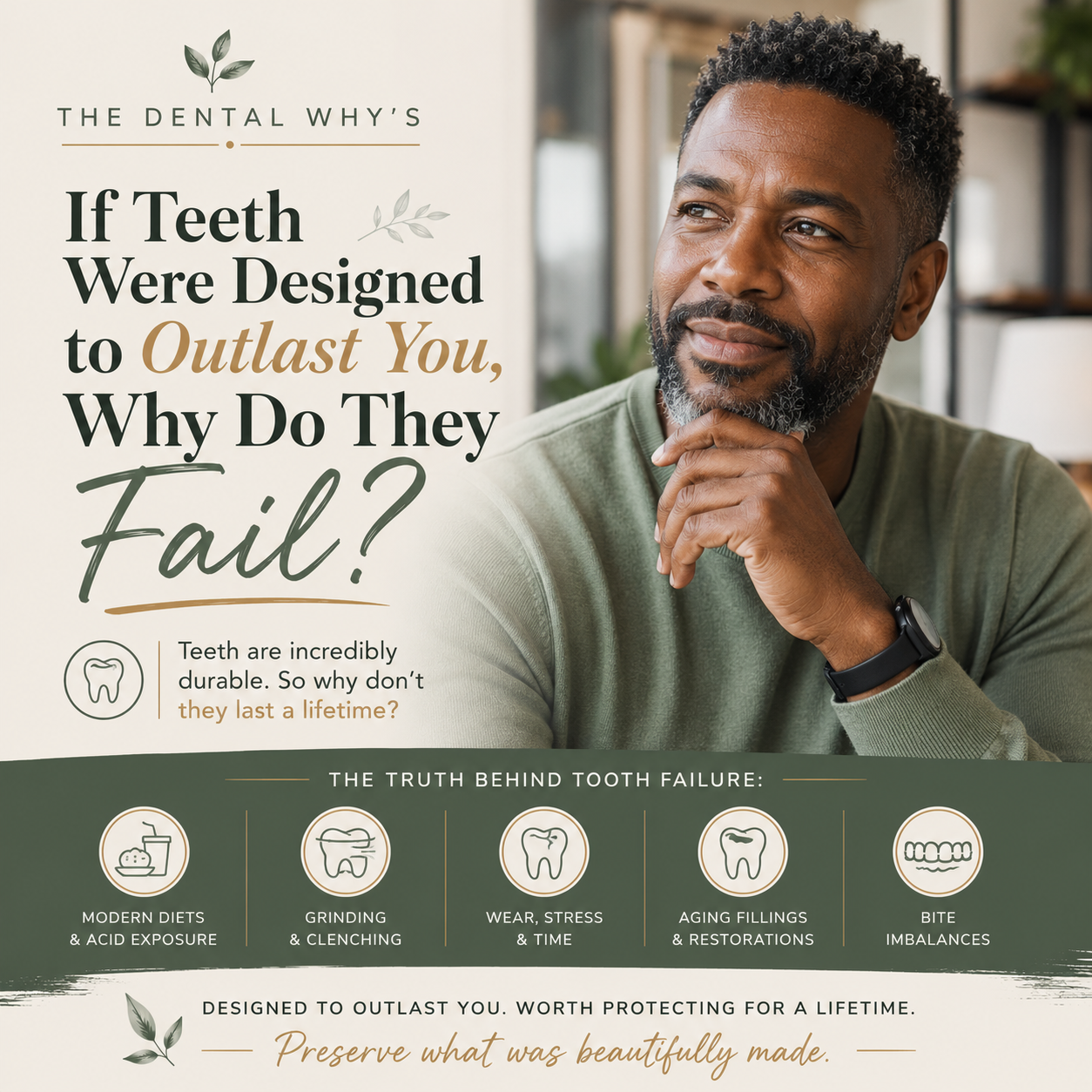
Dental Why's: Why Do We Lose Teeth If They Were Designed to Outlast You?
Teeth are among the most durable structures in the human body. In fact, they're often the last thing left behind. So why do so many fail long before we do? This Dental Why's explores the difference between how teeth were designed and how modern life challenges them.
What Richmond TX Patients Should Know About Wear, Decay, and Preserving Their Natural Teeth
Teeth are remarkable.
Long after skin, muscle, and even bone begin to disappear, teeth often remain.
In fact, archaeologists frequently identify ancient civilizations by the teeth they uncover.
Which raises an interesting question.
Here's the Dental Why's:
If teeth were designed to outlast you, why do they fail so often?
For many adults in Richmond TX and throughout Fort Bend County, the answer isn't that teeth are weak.
It's that modern life places demands on them they were never designed to face.
Teeth Were Built for a Lifetime
The enamel covering your teeth is the hardest substance in the human body.
Stronger than bone.
Designed to withstand decades of:
Chewing
Speaking
Temperature changes
Daily use
Your teeth were not designed to last ten years.
They were designed to last a lifetime.
In many ways, they were designed to outlast the rest of you.
So why don't they?
Modern Diets Changed the Rules
For most of human history, sugar was rare.
Today, it's everywhere.
Coffee drinks.
Sports drinks.
Energy drinks.
Snacks.
Processed foods.
The problem isn't just how much sugar we consume.
It's how often we consume it.
Every exposure creates an acidic environment that weakens enamel and feeds cavity-causing bacteria.
Teeth were designed for use.
They weren't designed for constant chemical attack.
We Live Longer Than Ever
Historically, many people simply didn't live long enough to experience decades of accumulated wear.
Today, people routinely live into their 70s, 80s, and beyond.
That means teeth must withstand:
More chewing cycles
More years of grinding
More years of acid exposure
More years of stress
Longevity is a gift.
But it creates new challenges for preserving natural teeth.
Small Problems Become Bigger Ones
Most dental problems don't begin as emergencies.
A cavity starts small.
A crack begins as a microscopic fracture.
A filling starts to leak around the edges.
The challenge is that these changes often occur without symptoms.
By the time pain appears, the damage has usually been developing for months—or years.
This is why routine dental visits matter.
Not because we're looking for problems.
Because we're trying to find them before they become bigger ones.
Teeth Don't Fail Overnight
Many patients say:
"My tooth suddenly broke."
But most teeth don't suddenly fail.
The break was sudden.
The weakening was gradual.
Years of:
Grinding
Clenching
Wear
Temperature changes
Aging restorations
Slowly reduce a tooth's ability to withstand stress.
Eventually, something gives.
The final crack is often just the last chapter of a much longer story.
Modern Dentistry Is About Preservation
One of the biggest misconceptions about dentistry is that it's primarily about fixing teeth.
The best dentistry is actually about preserving them.
Sometimes that means:
Preventing cavities
Replacing failing fillings
Protecting cracked teeth
Correcting bite imbalances
Straightening teeth with Invisalign
Restoring damaged enamel
Every decision should support the same goal:
Helping natural teeth last as long as possible.
The Bigger Dental Why's
If teeth were designed to outlast you, why do they fail?
Because design matters.
But environment matters too.
Teeth are incredibly durable.
Yet every day they face forces they were never intended to experience at the frequency modern life delivers them.
The good news is this:
Most tooth loss isn't inevitable.
Most dental problems aren't random.
And many of the factors that shorten the life of a tooth can be identified and addressed early.
The goal of dentistry isn't perfection.
It's stewardship.
Because if something was designed to last a lifetime, it's worth protecting.
Frequently Asked Questions
-
Yes. Enamel is the hardest substance in the human body, even stronger than bone.
-
Modern diets, grinding, aging restorations, acid exposure, and years of wear gradually weaken teeth over time.
-
Yes. With proper care, many people keep their natural teeth throughout their lives.
-
Accumulated stress from chewing, grinding, aging enamel, and older dental work increases fracture risk.
-
Consistent home care, routine dental visits, early treatment, and addressing bite issues before they cause damage.
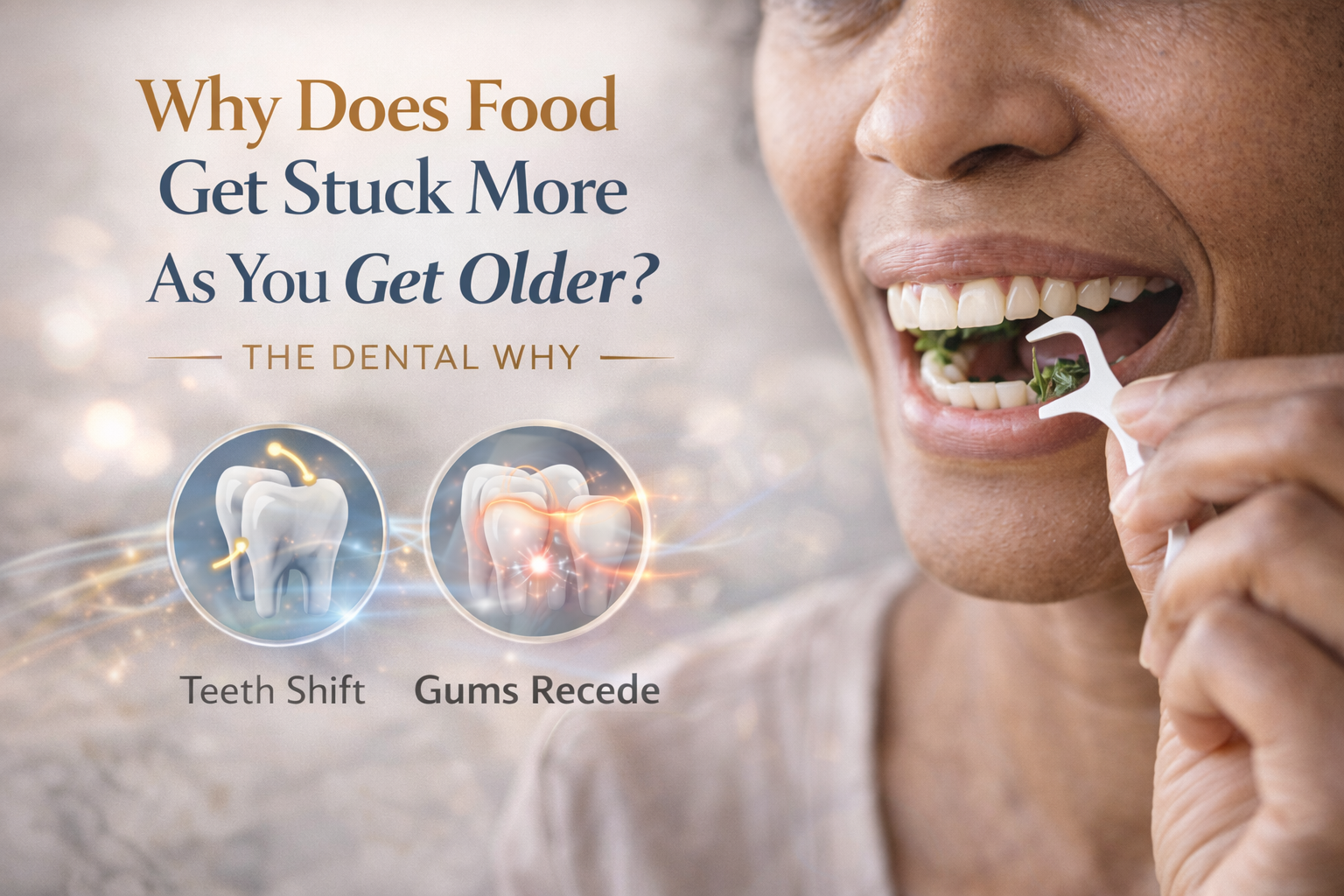
Dental Why’s: Why Does Food Get Stuck More As You Get Older?
If food is getting stuck more often, it’s not random. This Dental Why explores how tooth movement and gum changes create new spaces over time.
Gum Health and Tooth Movement in Richmond TX
You didn’t have this problem before.
Now suddenly:
Food gets stuck.
You feel pressure between teeth.
Floss catches in new places.
Here’s the Dental Why:
Why does food start getting stuck more as we get older?
For many patients in Richmond TX, the answer isn’t food.
It’s shifting.
Teeth Move — Even As Adults
Teeth are not fixed in place forever.
Over time, they:
Shift forward
Rotate slightly
Crowd together
Even small changes create new contact points.
And new gaps.
Gum Changes Create Space
Gums also change over time.
Mild recession can:
Expose root surfaces
Create tiny openings between teeth
Reduce natural protection
Food doesn’t get stuck randomly.
It gets trapped where structure has changed.
Why This Matters More Than You Think
Food trapping isn’t just annoying.
It can lead to:
Localized gum inflammation
Bad breath
Increased cavity risk between teeth
For adults in Fort Bend County, this is often an early sign of structural change.
How Invisalign Can Help
Many patients are surprised to learn:
Invisalign isn’t just cosmetic.
It can:
Re-establish proper contact between teeth
Reduce food traps
Improve cleanability
Support long-term gum health
Alignment restores function.
Not just appearance.
The Bigger Dental Why
Why do we accept small changes as “normal” when they signal something deeper?
Food getting stuck is feedback.
Your mouth is telling you something has shifted.
And small shifts, over time, become bigger problems.
FAQ
-
Tooth movement and gum changes create new spaces where food can collect.
-
Sometimes. It depends on the cause and severity.
-
In many cases, alignment can help restore proper spacing and function.
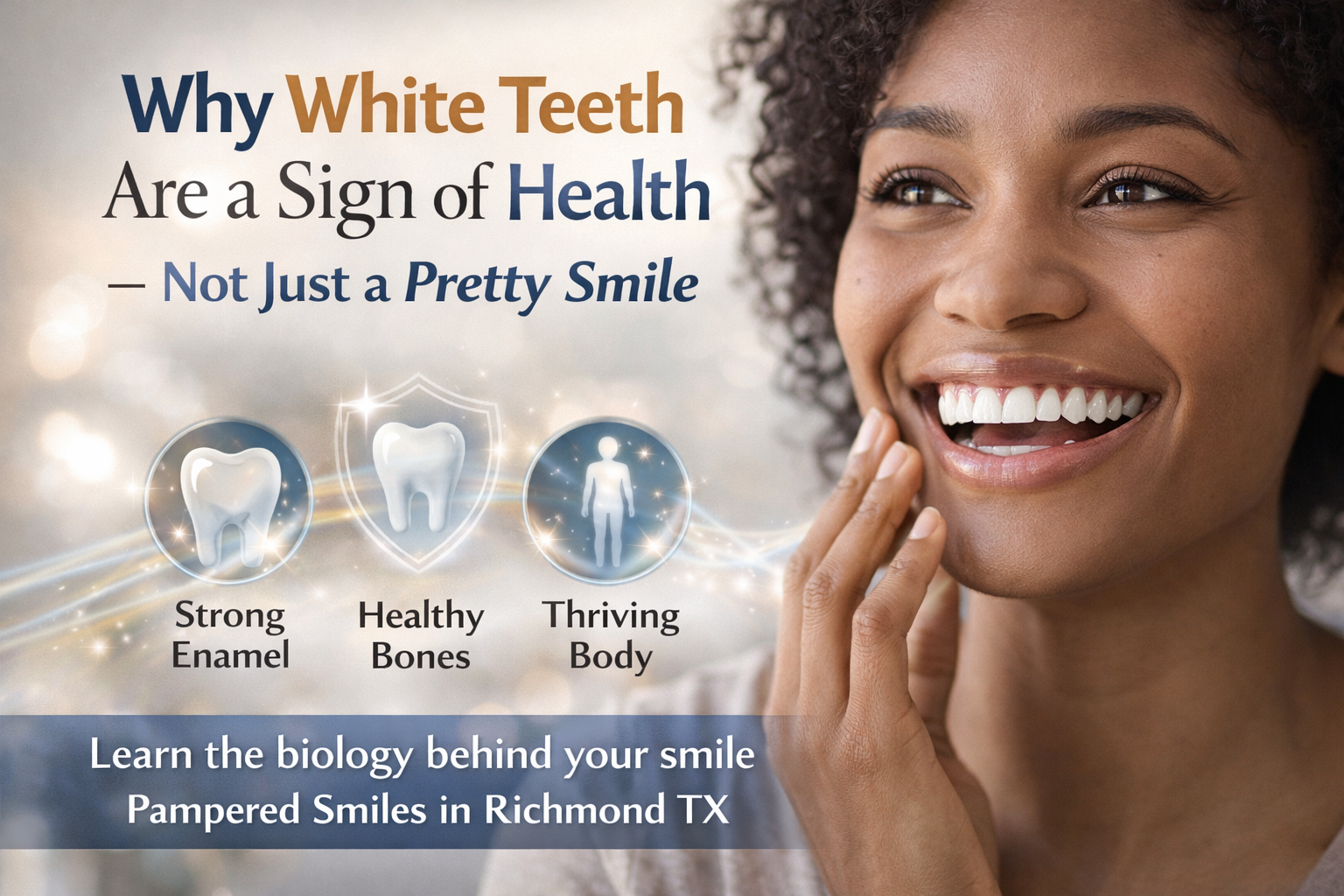
Dental Why’s: Why White Teeth Are a Sign of Health — Not Just a Pretty Smile
We're drawn to white smiles for reasons that go deeper than aesthetics. Naturally white teeth are one of the most honest signals your body sends about your overall health — and understanding what they mean changes how you think about your smile entirely.
We live in a world that treats white teeth as a beauty standard.
Whitening strips. Bleaching trays. Veneers. Filters.
But here's what the beauty industry never tells you — naturally white teeth aren't just attractive. They're biological. They're your body broadcasting something important about your health, your development, and your strength.
Here's the Dental Why.
What Makes Teeth White in the First Place
The whiteness of your teeth comes from enamel — the outermost layer of your tooth and the hardest substance in the human body. Harder than bone. Harder than most metals.
When enamel is thick, dense, and properly mineralized, it appears white, smooth, and slightly translucent in a way that reflects light naturally. That's the glow people associate with a healthy smile.
When enamel is thin, porous, worn, or damaged, the yellow dentin underneath starts to show through. Stains absorb more easily. The teeth look dull, flat, or discolored — not because they're dirty, but because the armor protecting them has been compromised.
So when you see naturally white teeth, you're not just seeing a cosmetic outcome. You're seeing strong enamel. And strong enamel tells a deeper story.
What Strong Enamel Says About Your Body
Enamel forms during childhood and adolescence. Once it's formed, your body cannot regenerate it. What you have is what you were given — shaped by your genetics, your nutrition, and the environment your teeth developed in.
Thick, healthy enamel is a sign that during those critical development years your body had what it needed — adequate calcium and phosphorus, sufficient vitamin D to absorb those minerals, stable hormones, and a diet that supported mineralization rather than undermined it.
In other words, strong enamel reflects strong bones. The same biological processes that build dense enamel build dense skeletal structure. A person with naturally thick, white enamel is often a person whose body mineralized well across the board.
That's not vanity. That's physiology.
Your Smile as a Biological Signal
Humans have always used visible physical traits to assess health — often without realizing it. It's wired into us.
A broad, symmetrical smile with white teeth signals several things simultaneously to the people around you. It signals that your jaw developed well, which means you likely had a healthy airway and adequate nutrition during growth. It signals that your immune system wasn't chronically depleted fighting oral infection. It signals that your body had the resources to build and maintain strong mineralized tissue.
In evolutionary terms, that makes you a strong candidate — as a partner, a collaborator, a leader. Research consistently shows that people with healthier-looking smiles are perceived as more confident, more competent, and more trustworthy — not because people are being superficial, but because on a biological level, the smile is communicating something real.
When your smile says you're thriving, people notice. You get chosen — for the job, for the photo, for the opportunity, for the relationship. Not because of the whiteness itself, but because of what the whiteness represents.
When White Teeth Can't Be Achieved With Whitening Alone
Here's where the Dental Why gets more nuanced.
Not all tooth discoloration is the same. And not all discoloration responds to whitening.
External staining — from coffee, tea, red wine, and tobacco — sits on the surface of the enamel and responds well to professional whitening treatments. This is the most common type and the most straightforward to address.
Intrinsic staining is different. It lives inside the tooth, embedded in the dentin or even the enamel structure itself. It often appears as a grayish, yellowish, or banded discoloration that whitening gel simply cannot penetrate.
The two most common causes of intrinsic staining are tetracycline antibiotic exposure during childhood tooth development, and fluorosis — overexposure to fluoride during the years when enamel was forming.
Here's something most people don't know: the same discoloration that shows up in intrinsically stained teeth often shows up in the nail beds too. Cloudy, striated, or banded nail beds can be a clue that the discoloration in your teeth is intrinsic — which means whitening trays alone won't solve it, and a different conversation about veneers or other options is worth having.
What to Do If Your Teeth Aren't Where You Want Them
If your teeth are stained, worn, or not reflecting the health you know you have — that gap between how you feel inside and how your smile looks on the outside matters.
It affects how freely you laugh. How confidently you speak. How you show up in photos, in meetings, in every interaction where your face is the first thing people see.
At Pampered Smiles in Richmond, TX we approach whitening and smile enhancement the right way — starting with understanding what kind of discoloration you have, what's driving it, and what solution will actually work for your specific teeth.
We don't just hand you a tray and send you home. We look at your enamel, your nail beds, your history, and your goals — and we build a plan that gives you a result that lasts.
Because your smile should reflect everything that's going right with you.
And when it does — you don't just look better.
You show up differently.
📅 Book a whitening consultation at Pampered Smiles — pamperyoursmile.com | (832) 271-5404
FREQUENTLY ASKED QUESTIONS
-
Yellowing can come from several sources — surface staining from food and drink, thinning enamel that reveals the yellow dentin beneath, or intrinsic staining from within the tooth structure itself. Brushing helps with surface buildup but cannot reverse enamel thinning or intrinsic discoloration. A professional evaluation will identify what's causing your specific discoloration and what will actually fix it.
-
Professional whitening performed correctly does not damage enamel. The bleaching agent works on the surface staining within enamel pores. However, overuse of whitening products or whitening teeth that have intrinsic staining will not produce results and can cause sensitivity without improving the color.
-
Intrinsic stains are discolorations embedded inside the tooth structure — often caused by tetracycline antibiotic exposure or fluorosis during childhood development. They do not respond to standard whitening treatments. Options for intrinsic staining typically include porcelain veneers or other restorative approaches.
-
The type of discoloration determines the solution. Surface stains respond to whitening. Intrinsic stains, significant enamel wear, or teeth with structural issues often require veneers or bonding for a lasting result. At Pampered Smiles we assess your specific situation before recommending any treatment.
-
We offer professional in-office whitening as well as take-home whitening systems customized to your teeth. For patients with intrinsic staining or more significant cosmetic concerns, we provide comprehensive smile consultations that include veneer options and full smile design planning.
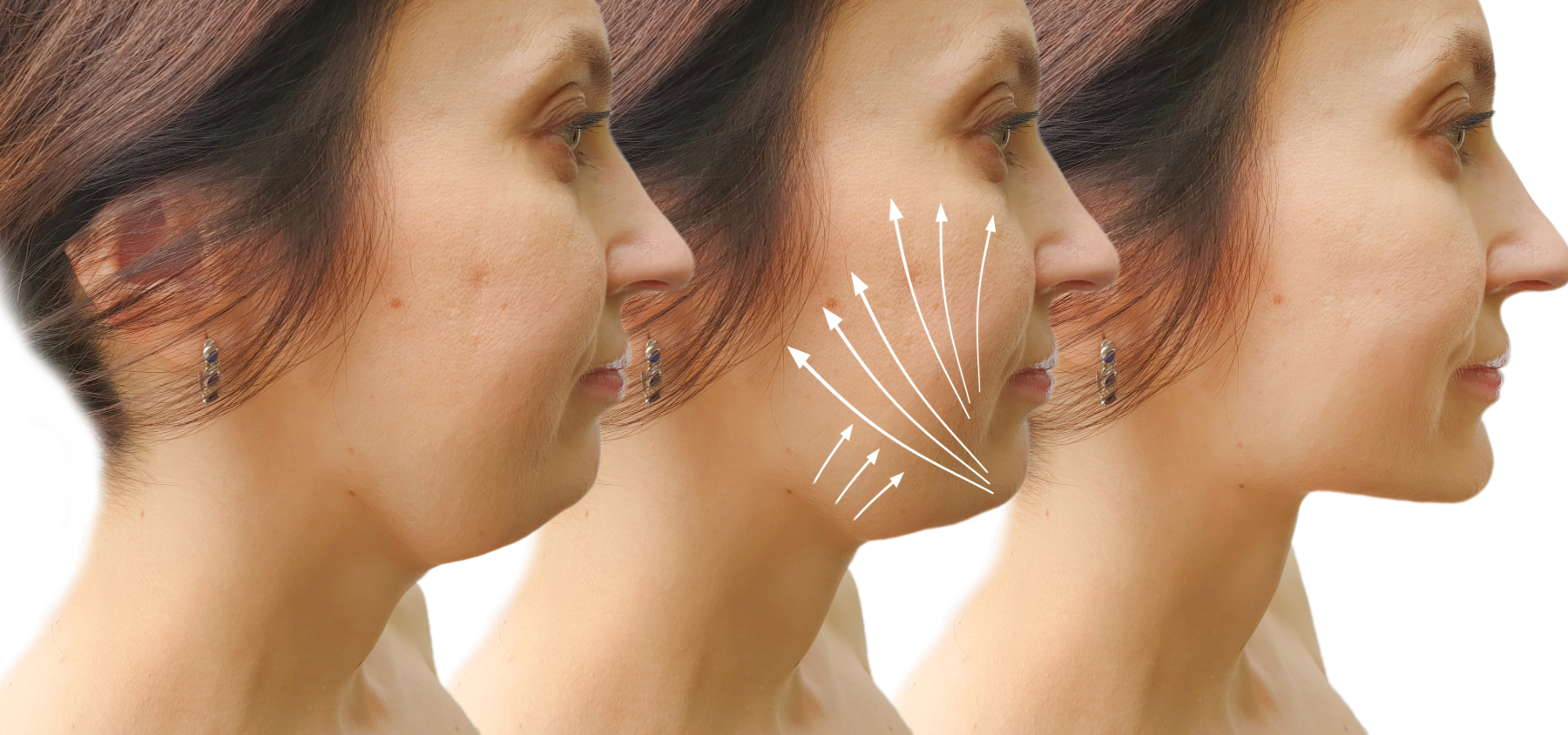
Dental Why’s: Why Your Tongue Is Secretly Ruining Your Airway and Your Smile
Most people blame their genes when their teeth are crowded or their breathing feels off. But the real culprit might be something you've never thought to check — your tongue. Where it rests, how it moves, and whether it's being held back could be quietly shaping your face, your airway, and your smile every single day.
You brush. You floss. You've had braces.
But your teeth are still shifting. Your jaw feels tight. You wake up tired no matter how long you sleep.
Nobody told you to check your tongue.
Here's the Dental Why.
Your Tongue Is Nature's Jaw Expander
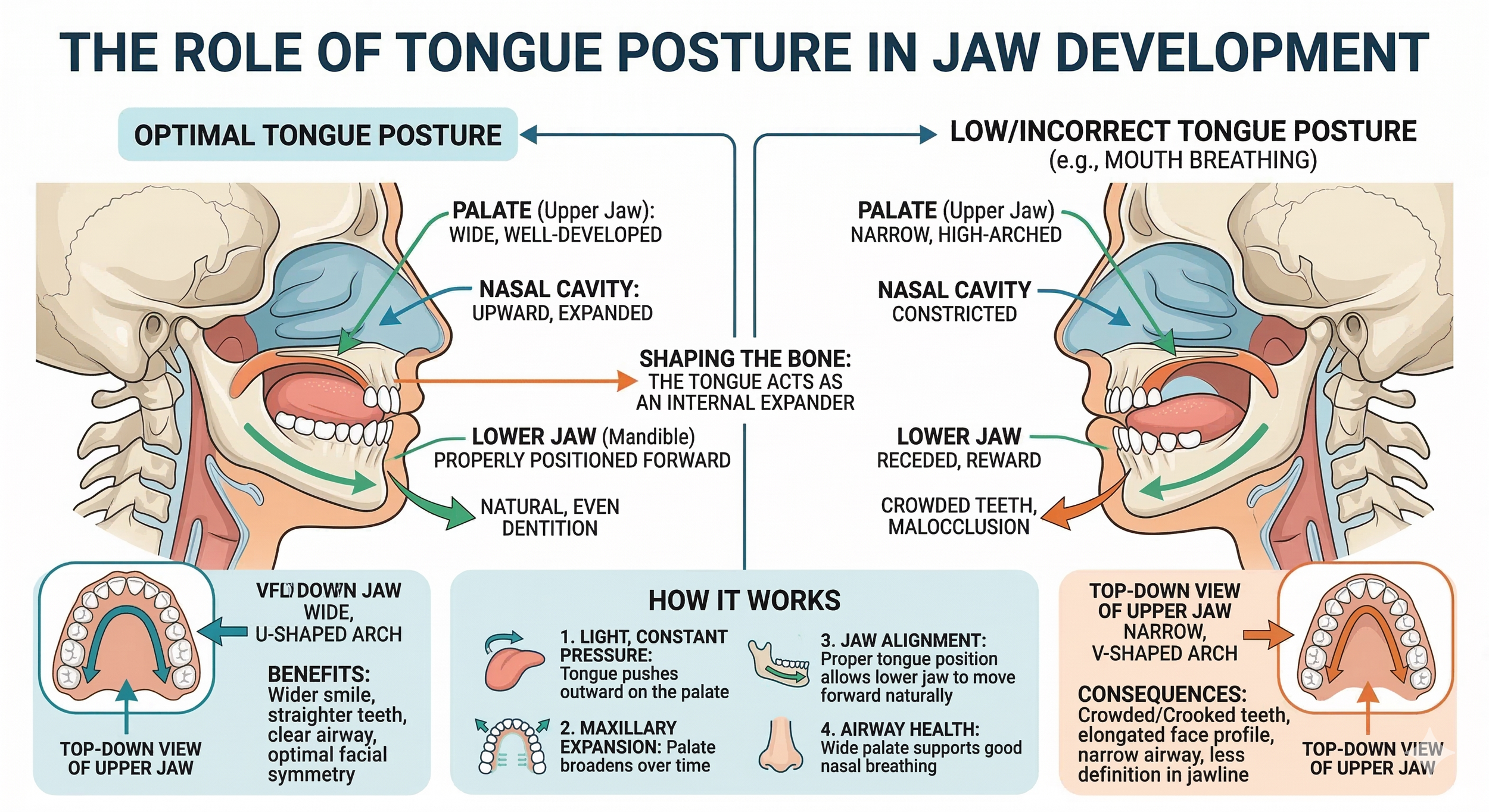
Most people think of the tongue as a tool for eating and talking. But developmentally, your tongue is one of the most powerful forces shaping your face.
When your tongue rests correctly — pressed gently against the roof of your mouth — it acts as a natural expander. That constant, gentle upward pressure guides your upper jaw to grow wide and forward. It creates space for your teeth to come in straight. It keeps your airway open.
Wherever your tongue rests is where it expands. The tongue is nature's built-in orthodontic appliance — and most people never know it.
But when the tongue rests low, hangs forward, or is physically restricted from lifting — everything changes.
What Happens When the Tongue Can't Do Its Job
A tongue that doesn't rest on the roof of the mouth doesn't guide the jaw to grow properly. The result is a narrow upper arch — not enough space for teeth to come in straight. That crowding you see? It often starts here.
And it doesn't stop at the teeth.
A narrow jaw means a narrower airway. A narrower airway means your body has to work harder to breathe — especially at night. That's where snoring, mouth breathing, restless sleep, and even sleep apnea can begin.
Signs your tongue may not be doing its job include crowded or overlapping teeth, a narrow upper arch, forward head posture, snoring or mouth breathing, restless sleep or fatigue, speech delays in children, and dark circles under the eyes from reduced oxygen.
All of these can trace back to one small muscle not sitting in the right place.
Tongue Thrust and the Open Bite Connection
Some people don't just have a low-resting tongue — they have a tongue thrust. This means that during swallowing, speaking, or at rest, the tongue pushes forward against the front teeth instead of lifting to the roof of the mouth.
Every time you swallow — which happens over 1,000 times a day — that forward pressure pushes against your front teeth. Over time, the teeth can't close together properly. That gap between the upper and lower front teeth is called an anterior open bite, and it is almost always a tongue story.
The tongue is the most powerful muscle in the body relative to its size. When it's working against your teeth instead of with them, the bite loses.
Try This Right Now
Here's a quick test. Try lifting your entire tongue — not just the tip — all the way to the roof of your mouth.
Now pay attention to your feet.
Did you feel tension in your toes, or notice one of them lift slightly?
That's fascia — the thin connective tissue that runs through your entire body like a full-body suit, connecting everything from your tongue all the way down to your toes. If you felt that pull, your tongue may be restricted. That restriction travels the full length of your body through the fascial chain.
That little toe that rides up and never quite lies flat? It might have been telling you about your tongue this whole time.
What Is a Tongue Tie — and Why Does It Matter?
A tongue tie — clinically called ankyloglossia — is when the frenum, the band of tissue connecting the underside of the tongue to the floor of the mouth, is too tight or too short. It physically prevents the tongue from lifting properly.
Tongue ties are often missed because they don't always look dramatic. Some are visible. Many are posterior, meaning they sit further back and are only identified by function, not appearance.
In infants, a tongue tie can cause difficulty breastfeeding, poor latch, and slow weight gain. In children, it shows up as speech delays, mouth breathing, snoring, or a narrow face. In adults, the effects have often compounded for years — showing up as chronic jaw tension, headaches, crowded teeth, and poor sleep quality.
What Parents Need to Know
If you have children, this section is for you.
The jaw develops most rapidly in the first few years of life. How a child breathes, swallows, and holds their tongue during those critical years directly shapes the face they will grow into.
Signs that your child's tongue or airway may need evaluation include mouth breathing during the day or while sleeping, snoring or noisy breathing at night, restless sleep or night terrors, a narrow face or crowded baby teeth, speech sounds that are difficult to produce, difficulty breastfeeding as an infant, and a ride-along toe — one toe that consistently lifts or overlaps.
Early intervention doesn't just protect the smile. It protects the airway, the brain, and the quality of sleep that drives everything from behavior to learning.
You can help guide your child's facial development from day one. Encouraging chewing of real, textured foods, correcting mouth breathing early, and having tongue function evaluated can make a significant difference in the face and airway your child develops.
This Is Bigger Than Crooked Teeth
Oxygen is life. When your airway is restricted — whether because of tongue position, a narrow jaw, or mouth breathing — your brain gets less of what it needs to function, repair, and rest.
Children with untreated airway issues often struggle with focus, behavior, and learning — not because of a neurological problem, but because they are chronically sleep-deprived from poor breathing at night.
Adults with untreated tongue ties and narrow airways often cope with morning headaches, jaw pain, fatigue, and acid reflux without ever connecting it back to the mouth.
The alignment of your tongue, teeth, and jaw isn't cosmetic. It's foundational.
What We Do at Pampered Smiles Dentistry
At Pampered Smiles Dentistry in Richmond, TX, we don't just look at your teeth. We assess your tongue posture, your airway, your swallowing pattern, and your breathing habits — because we understand that crooked teeth and a crowded smile are often symptoms, not the root cause.
Whether you're an adult who has been told you grind your teeth, snore, or have jaw tension — or a parent who wants to get ahead of airway issues for your child — we are here to look at the whole picture.
Because sometimes, to truly understand your smile, you have to look all the way down to your toes.
FREQUENTLY ASKED QUESTIONS
-
Yes. The tongue is one of the primary forces guiding jaw and dental development. When it rests low or pushes forward instead of sitting on the roof of the mouth, it fails to stimulate proper upper jaw growth — leading to crowding, narrow arches, and bite problems.
-
A tongue tie is when the tissue connecting the underside of your tongue to the floor of your mouth is too tight, preventing the tongue from lifting fully. Signs include difficulty lifting the tongue to the roof of the mouth, a heart-shaped tongue tip, speech issues, snoring, jaw tension, and difficulty with certain foods. Many tongue ties are not visible and require a functional assessment.
-
Yes. A restricted tongue tends to rest low in the mouth, which can narrow the airway and contribute to mouth breathing, snoring, and disrupted sleep. Over time, this can affect energy levels, concentration, and overall health.
-
Snoring in children is not normal and is worth evaluating. It can signal airway restriction, tongue positioning issues, enlarged tonsils, or other factors. Early assessment allows for intervention during the years when the jaw is most responsive to guidance.
-
We provide comprehensive airway and tongue evaluations for both children and adults. If a tongue tie or functional issue is identified, we will walk you through your options and next steps as part of a whole-health approach to your smile.
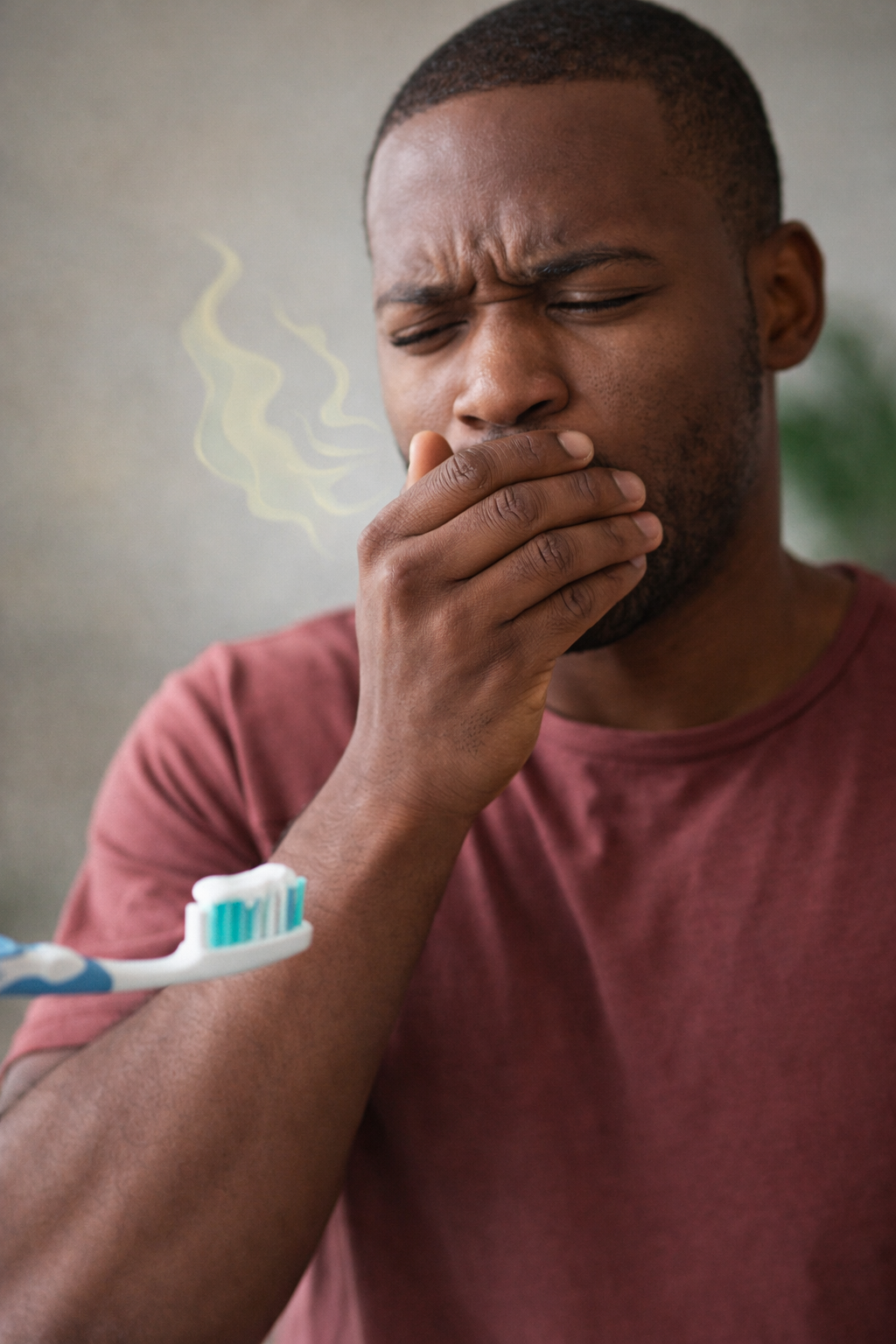
Dental Why’s: Why Brushing, Flossing, and Mouthwash Won't Work When Bacteria Is Left to Poop in Your Mouth
You brush twice a day. You floss. You even use a Waterpik. So why does your breath still smell? The answer has nothing to do with your toothbrush — and everything to do with what bacteria leave behind.
So you haven't been to the dentist in over a year.
But you brush twice a day, floss after every meal, use a Waterpik, and rinse with mouthwash.
You've tried everything you know to get rid of your bad breath.
But nothing works.
Here's the Dental Why — and it's not what most people expect.
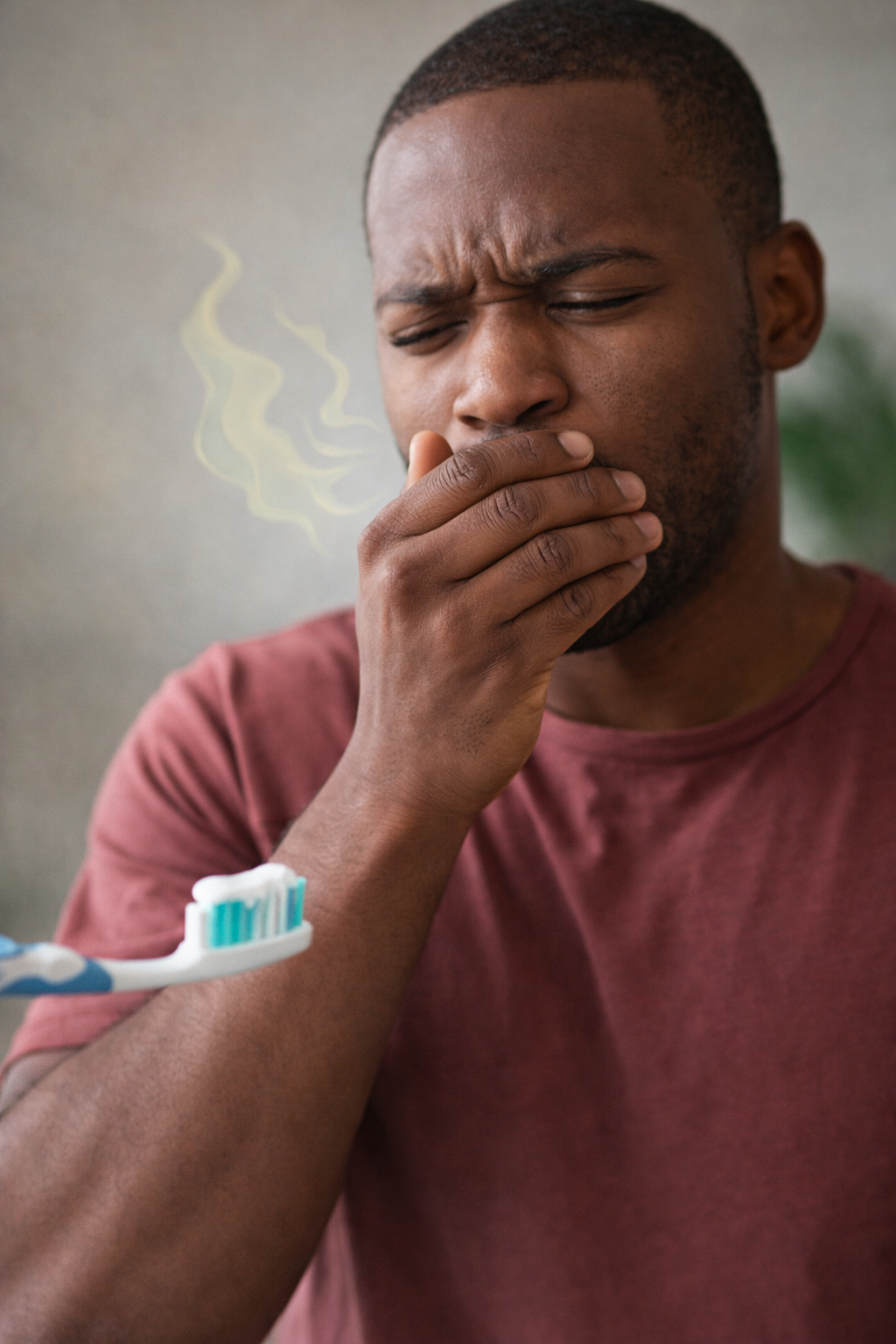
It's Not Your Routine. It's Bacteria Poop.
Yes. You read that right.
The bacteria living in your mouth feed on leftover food particles — especially sugars and carbs. And like every living organism, what goes in must come out.
Their waste? Smelly sulfur gases — the same compounds found in rotten eggs.
That odor you can't shake? It's not your toothbrush. It's bacterial waste building up in places you can't fully reach on your own.
Why Your Toothbrush Can't Win This Battle Alone
Here's where the science gets important.
Plaque is like wet mud — easy to rinse away if you catch it early. Brushing and flossing work well when done consistently and right after eating.
But leave that plaque for just 24 to 72 hours?
It hardens into tartar — the dental equivalent of mud drying into cement.
And once that happens, no toothbrush, no floss, no mouthwash can remove it. Not even a Waterpik.
If you're brushing but not flossing consistently, the soft plaque hiding between your teeth is hardening right now — and by the time you pick up the floss, it's already too late for that spot.
What Tartar Actually Does Inside Your Mouth
Tartar doesn't just sit there quietly. It's destructive.
Once it forms, it traps odor-causing bacteria deep under your gumline, keeps your immune system in a constant state of inflammation, causes your gums to bleed — which is not normal and is your body's distress signal — and breaks down bone and gum tissue over time.
That persistent bad breath isn't just embarrassing. It's a sign your immune system is exhausted from fighting a daily war it wasn't meant to fight alone.
Your gums should never bleed when you brush. Bleeding gums are your body saying: I need backup.
Why Coming Once a Year Isn't Enough
If you visit the dentist once a year and call it done — your mouth is spending the other 11 months allowing tartar to accumulate, bacteria to multiply, and your immune system to stay on high alert.
Most people need a professional cleaning every 3 to 6 months to stay ahead of the buildup. Some patients with active gum disease need even more frequent visits.
Professional cleanings don't just polish your teeth. They break down tartar that cannot be removed at home, clear bacteria from below the gumline, give your immune system the break it desperately needs, and stop the cycle of chronic oral inflammation.
Stop Your Mouth from Being a Latrine
When bacteria are feeding and pooping in your mouth 24 hours a day — and no one's showing up to clean house — your mouth becomes a breeding ground for infection.
No amount of home care can keep up with that.
The solution isn't a better mouthwash. The solution is removing the hardened buildup that's feeding the problem and giving your body a real reset.
Ready to Actually Fix Your Bad Breath?
At Pampered Smiles in Richmond, TX, we don't just clean teeth — we restore balance.
A professional cleaning at Pampered Smiles will remove tartar that brushing and flossing can't touch, clear bacteria from below the gumline, reduce inflammation and give your immune system real relief, and leave your mouth feeling genuinely fresh — not just mint-flavored.
And if you really want to clean house? Ask us about our laser therapy — the deep clean your gums have been waiting for.
FREQUENTLY ASKED QUESTIONS
-
Brushing only reaches about 60% of your tooth surfaces. The bacteria between teeth and below the gumline — where tartar forms — can't be removed by brushing alone. A professional cleaning is the only way to clear that buildup.
-
Plaque can begin hardening into tartar in as little as 24 to 72 hours. Once hardened, it cannot be removed with a toothbrush or floss — only professional dental instruments can break it down.
-
Bleeding gums are a sign of inflammation — your immune system actively fighting bacterial infection at the gumline. This is not normal and is an early warning sign of gum disease. A professional cleaning can help reverse this.
-
Most adults benefit from a cleaning every 3 to 6 months. Patients with active gum disease, heavy tartar buildup, or a history of periodontal issues may need more frequent visits.
-
Yes. For patients with tartar below the gumline or early-to-moderate gum disease, we offer scaling and root planing (deep cleaning) as well as laser therapy for a more thorough treatment.

Dental Why’s: If We Get a Trial Set of Teeth… Why Do So Many Adults Still Live with Crooked Ones?
If we’re given a trial set of teeth, why do so many adults accept crooked ones as permanent? This Dental Why explores how Invisalign in Richmond TX protects both confidence and long-term oral health.
We’re born with a trial set of teeth.
They’re temporary. They fall out. They make room for something stronger.
Growth is built into the design.
So here’s the Dental Why:
If we were given a practice set… why do so many adults believe crooked teeth are permanent?
If you’re searching for Invisalign in Richmond TX or considering a smile makeover in Fort Bend County, this question matters more than you think.
Teeth Were Designed to Change
Baby teeth aren’t mistakes. They’re preparation.
But once adult teeth settle in, many people assume:
“This is just how my smile is.”
The truth?
Teeth continue shifting throughout life.
Across Richmond, Sugar Land, and Fort Bend County, we commonly see adults experiencing:
Increasing crowding in their 30s and 40s
Gaps widening over time
Bite imbalances
Uneven wear from grinding
Tension headaches caused by misalignment
Alignment isn’t just cosmetic.
It affects gum health, jaw comfort, enamel preservation, and long-term stability.
Crooked teeth are often not permanent flaws.
They’re untreated movement.
And movement can be corrected.
Why Adults in Richmond TX Are Choosing Invisalign

Invisalign clear aligners in Richmond TX
Modern orthodontics looks very different than it did 20 years ago.
With Invisalign treatment in Richmond TX, adults can straighten their teeth discreetly and comfortably — without metal braces.
Clear aligners are:
Nearly invisible
Removable for meals and brushing
Digitally mapped with 3D imaging
Designed for busy professional lifestyles
Straight teeth are easier to clean.
Easier to clean means healthier gums.
Healthier gums protect your natural teeth longer.
That’s not vanity.
That’s preventative care.
Crooked Teeth Cost More Over Time
Many adults say:
“They don’t hurt. They’re just slightly crooked.”
But clinically, we often see:
Chipping along front teeth
Gum recession around crowded areas
Flattened biting edges
Stress fractures from uneven force
When teeth aren’t aligned, pressure isn’t distributed evenly.
Over time, that imbalance wears enamel down.
Invisalign doesn’t just straighten teeth.
It creates a balanced bite — and balance protects your natural tooth structure.
Why Invisalign Often Comes Before a Smile Makeover
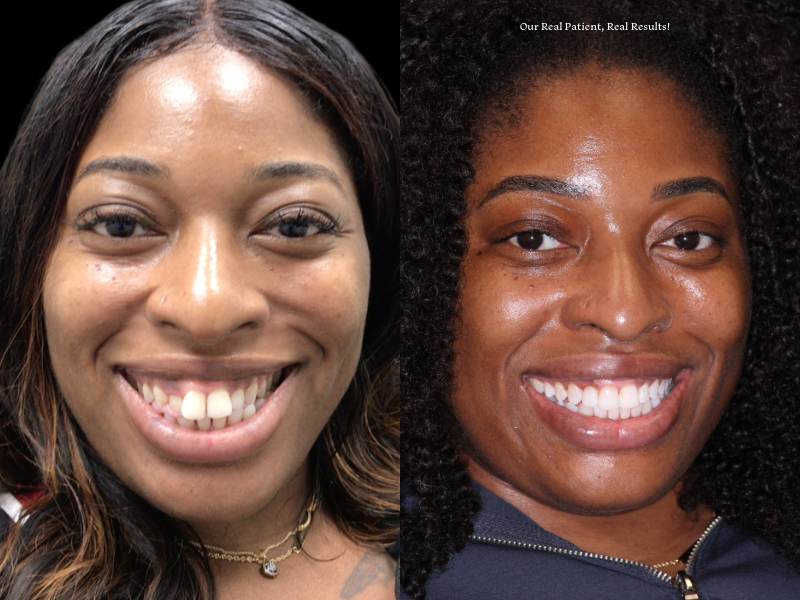
If you’re considering porcelain veneers in Richmond TX, alignment matters first.
Placing veneers on crooked teeth often requires:
More enamel removal
Bulkier restorations
Compromised gum symmetry
When we align teeth first, we can often:
Preserve more natural enamel
Improve spacing
Create better symmetry
Deliver longer-lasting results
In many cases, Invisalign makes cosmetic dentistry more conservative — not more aggressive.
Alignment first. Enhancement second.
That order protects your natural teeth.
Many patients choose a comprehensive smile transformation through our smile makeover services in Fort Bend County.
Why Local Invisalign Treatment in Fort Bend County Matters
Choosing a provider close to home matters.
Patients in Richmond TX and throughout Fort Bend County value consistent follow-up care and long-term accountability.
In-office Invisalign treatment allows for:
Professional bite evaluation
Ongoing monitoring
Precise tracking of tooth movement
Adjustments when needed
Immediate support if concerns arise
Mail-order aligners cannot evaluate your bite in person.
Dental tourism cannot provide long-term follow-up.
Your smile affects your health for decades.
It deserves careful planning — close to home.
Frequently Asked Questions About Invisalign in Richmond TX
How much does Invisalign cost in Richmond TX?
Cost depends on the complexity of your case. During your Invisalign consultation in Richmond TX, we provide a personalized treatment plan and discuss flexible payment options.
Do I need Invisalign before veneers in Fort Bend County?
In many cases, yes. Aligning teeth first allows veneers to be placed more conservatively and improves long-term stability and bite balance.
How long does Invisalign take for adults?
Most adult Invisalign cases range from 6–18 months depending on crowding, spacing, and bite correction needs.
Is Invisalign painful?
You may feel mild pressure for a few days when switching aligners, but most patients find Invisalign significantly more comfortable than traditional braces.
If you’re considering Invisalign in Richmond TX, schedule a consultation to explore your options.