
Dental Why’s: Why Your Tongue Is Secretly Ruining Your Airway and Your Smile
You brush. You floss. You've had braces.
But your teeth are still shifting. Your jaw feels tight. You wake up tired no matter how long you sleep.
Nobody told you to check your tongue.
Here's the Dental Why.
Your Tongue Is Nature's Jaw Expander
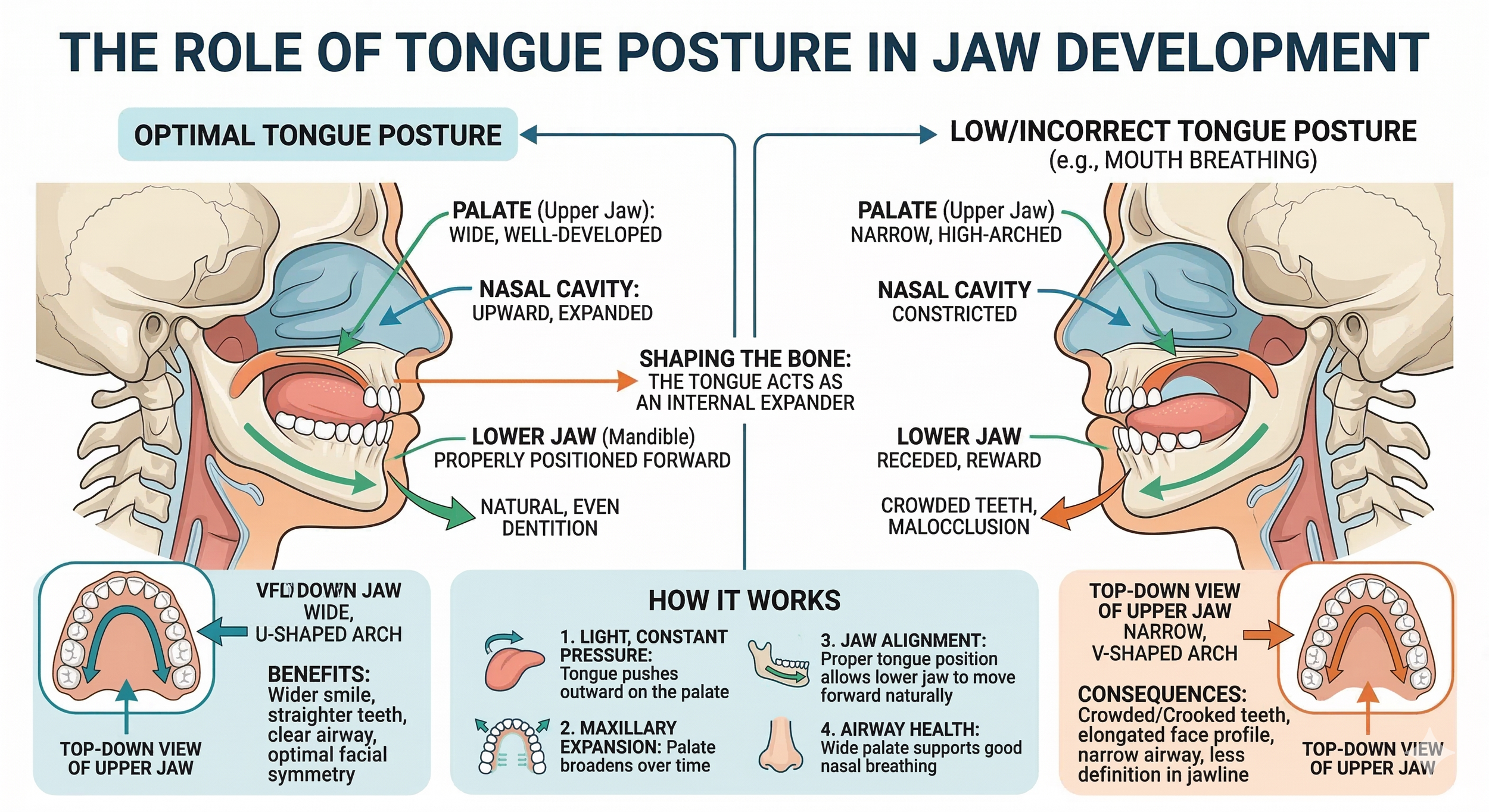
Most people think of the tongue as a tool for eating and talking. But developmentally, your tongue is one of the most powerful forces shaping your face.
When your tongue rests correctly — pressed gently against the roof of your mouth — it acts as a natural expander. That constant, gentle upward pressure guides your upper jaw to grow wide and forward. It creates space for your teeth to come in straight. It keeps your airway open.
Wherever your tongue rests is where it expands. The tongue is nature's built-in orthodontic appliance — and most people never know it.
But when the tongue rests low, hangs forward, or is physically restricted from lifting — everything changes.
What Happens When the Tongue Can't Do Its Job
A tongue that doesn't rest on the roof of the mouth doesn't guide the jaw to grow properly. The result is a narrow upper arch — not enough space for teeth to come in straight. That crowding you see? It often starts here.
And it doesn't stop at the teeth.
A narrow jaw means a narrower airway. A narrower airway means your body has to work harder to breathe — especially at night. That's where snoring, mouth breathing, restless sleep, and even sleep apnea can begin.
Signs your tongue may not be doing its job include crowded or overlapping teeth, a narrow upper arch, forward head posture, snoring or mouth breathing, restless sleep or fatigue, speech delays in children, and dark circles under the eyes from reduced oxygen.
All of these can trace back to one small muscle not sitting in the right place.
Tongue Thrust and the Open Bite Connection
Some people don't just have a low-resting tongue — they have a tongue thrust. This means that during swallowing, speaking, or at rest, the tongue pushes forward against the front teeth instead of lifting to the roof of the mouth.
Every time you swallow — which happens over 1,000 times a day — that forward pressure pushes against your front teeth. Over time, the teeth can't close together properly. That gap between the upper and lower front teeth is called an anterior open bite, and it is almost always a tongue story.
The tongue is the most powerful muscle in the body relative to its size. When it's working against your teeth instead of with them, the bite loses.
Try This Right Now
Here's a quick test. Try lifting your entire tongue — not just the tip — all the way to the roof of your mouth.
Now pay attention to your feet.
Did you feel tension in your toes, or notice one of them lift slightly?
That's fascia — the thin connective tissue that runs through your entire body like a full-body suit, connecting everything from your tongue all the way down to your toes. If you felt that pull, your tongue may be restricted. That restriction travels the full length of your body through the fascial chain.
That little toe that rides up and never quite lies flat? It might have been telling you about your tongue this whole time.
What Is a Tongue Tie — and Why Does It Matter?
A tongue tie — clinically called ankyloglossia — is when the frenum, the band of tissue connecting the underside of the tongue to the floor of the mouth, is too tight or too short. It physically prevents the tongue from lifting properly.
Tongue ties are often missed because they don't always look dramatic. Some are visible. Many are posterior, meaning they sit further back and are only identified by function, not appearance.
In infants, a tongue tie can cause difficulty breastfeeding, poor latch, and slow weight gain. In children, it shows up as speech delays, mouth breathing, snoring, or a narrow face. In adults, the effects have often compounded for years — showing up as chronic jaw tension, headaches, crowded teeth, and poor sleep quality.
What Parents Need to Know
If you have children, this section is for you.
The jaw develops most rapidly in the first few years of life. How a child breathes, swallows, and holds their tongue during those critical years directly shapes the face they will grow into.
Signs that your child's tongue or airway may need evaluation include mouth breathing during the day or while sleeping, snoring or noisy breathing at night, restless sleep or night terrors, a narrow face or crowded baby teeth, speech sounds that are difficult to produce, difficulty breastfeeding as an infant, and a ride-along toe — one toe that consistently lifts or overlaps.
Early intervention doesn't just protect the smile. It protects the airway, the brain, and the quality of sleep that drives everything from behavior to learning.
You can help guide your child's facial development from day one. Encouraging chewing of real, textured foods, correcting mouth breathing early, and having tongue function evaluated can make a significant difference in the face and airway your child develops.
This Is Bigger Than Crooked Teeth
Oxygen is life. When your airway is restricted — whether because of tongue position, a narrow jaw, or mouth breathing — your brain gets less of what it needs to function, repair, and rest.
Children with untreated airway issues often struggle with focus, behavior, and learning — not because of a neurological problem, but because they are chronically sleep-deprived from poor breathing at night.
Adults with untreated tongue ties and narrow airways often cope with morning headaches, jaw pain, fatigue, and acid reflux without ever connecting it back to the mouth.
The alignment of your tongue, teeth, and jaw isn't cosmetic. It's foundational.
What We Do at Pampered Smiles Dentistry
At Pampered Smiles Dentistry in Richmond, TX, we don't just look at your teeth. We assess your tongue posture, your airway, your swallowing pattern, and your breathing habits — because we understand that crooked teeth and a crowded smile are often symptoms, not the root cause.
Whether you're an adult who has been told you grind your teeth, snore, or have jaw tension — or a parent who wants to get ahead of airway issues for your child — we are here to look at the whole picture.
Because sometimes, to truly understand your smile, you have to look all the way down to your toes.
FREQUENTLY ASKED QUESTIONS
-
Yes. The tongue is one of the primary forces guiding jaw and dental development. When it rests low or pushes forward instead of sitting on the roof of the mouth, it fails to stimulate proper upper jaw growth — leading to crowding, narrow arches, and bite problems.
-
A tongue tie is when the tissue connecting the underside of your tongue to the floor of your mouth is too tight, preventing the tongue from lifting fully. Signs include difficulty lifting the tongue to the roof of the mouth, a heart-shaped tongue tip, speech issues, snoring, jaw tension, and difficulty with certain foods. Many tongue ties are not visible and require a functional assessment.
-
Yes. A restricted tongue tends to rest low in the mouth, which can narrow the airway and contribute to mouth breathing, snoring, and disrupted sleep. Over time, this can affect energy levels, concentration, and overall health.
-
Snoring in children is not normal and is worth evaluating. It can signal airway restriction, tongue positioning issues, enlarged tonsils, or other factors. Early assessment allows for intervention during the years when the jaw is most responsive to guidance.
-
We provide comprehensive airway and tongue evaluations for both children and adults. If a tongue tie or functional issue is identified, we will walk you through your options and next steps as part of a whole-health approach to your smile.