

Dental Education & Cosmetic Insights in Richmond TX
Our dental blog shares expert insights on Invisalign, smile makeovers, veneers, and preventive care for patients in Richmond TX and throughout Fort Bend County. We believe informed patients make confident decisions about their oral health.
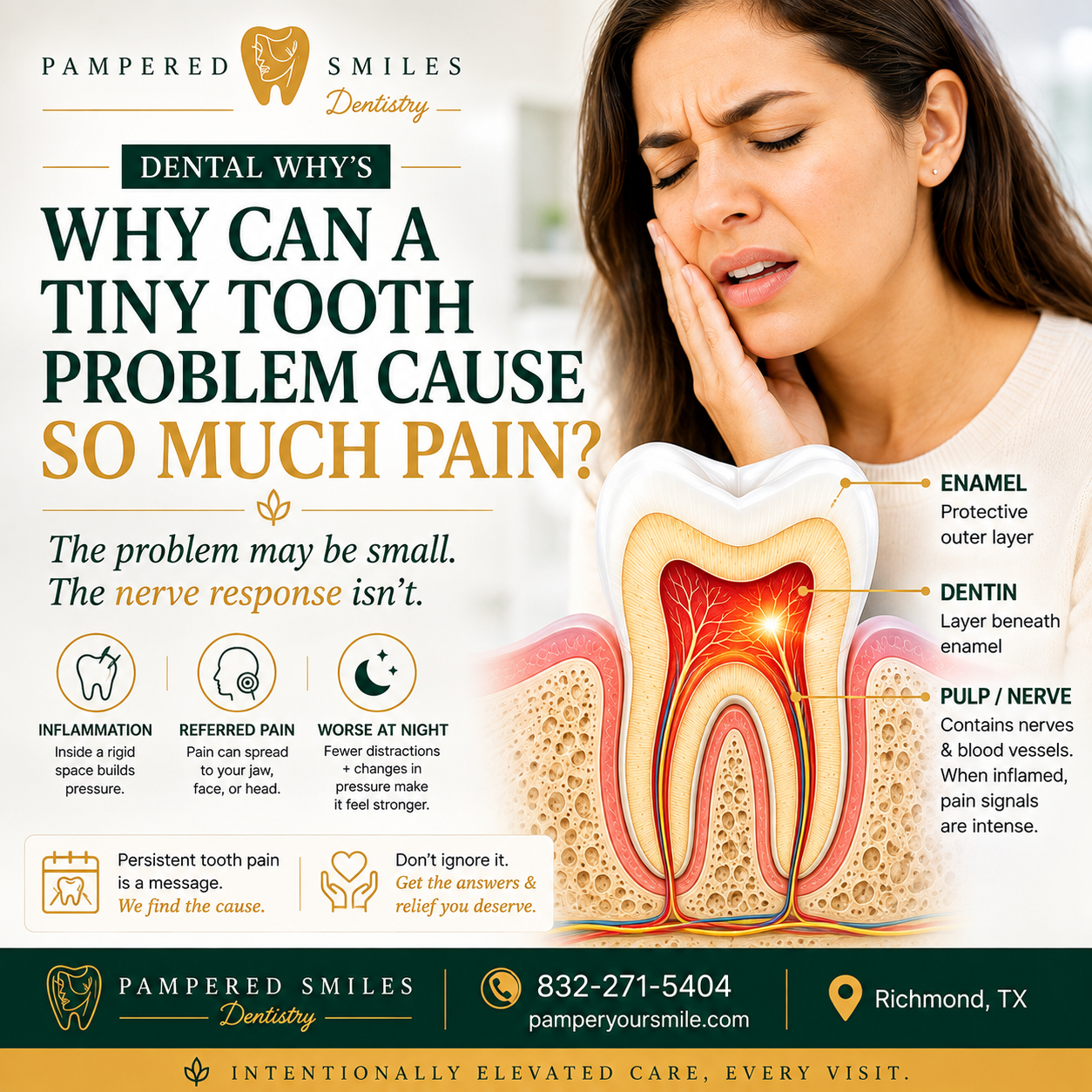
Dental Why's: Why Can a Tiny Tooth Problem Cause So Much Pain?
A tooth is small, but a toothache can make your entire jaw—or even your head—hurt. The reason has everything to do with the remarkable anatomy hidden inside your teeth.
Understanding Why Toothaches Can Feel So Much Bigger Than the Tooth Causing Them
Why Can a Tiny Tooth Problem Cause So Much Pain?
A tooth is only a few centimeters long.
Yet when one really hurts...
it can feel like your entire face knows about it.
You may struggle to sleep.
You can't concentrate.
You can't chew comfortably.
Sometimes you can't even tell which tooth is actually causing the problem.
How can something so small create pain that feels so enormous?
Here's the Dental Why's:
Why can a tiny tooth problem cause so much pain?
Because underneath that hard exterior is something you probably don't think about until there's a problem:
living tissue packed with nerves and blood vessels.
And when that tissue becomes inflamed, there's very little room for it to go.
Your Tooth Isn't Solid
Teeth look like solid pieces of enamel.
But they're actually layered structures.
On the outside is enamel—the incredibly hard material protecting the crown of your tooth.
Underneath is dentin, which makes up much of the tooth's structure.
And deep in the center is the pulp.
The pulp contains:
Nerves
Blood vessels
Connective tissue
Those tissues enter through tiny openings near the roots of the tooth.
In other words:
Your tooth is alive.
The Problem With Being Surrounded by Something Hard
Think about what happens when you sprain your ankle.
The injured tissue becomes inflamed.
It swells.
There's room around that tissue for expansion.
Now imagine inflammation developing inside a rigid container that can't expand.
That's closer to what can happen inside a tooth.
When the pulp becomes significantly inflamed, pressure can build within the confined space inside the tooth.
And the nerves living there aren't happy about it.
That's one reason dental pain can become intense.
How Does the Nerve Become Inflamed?
There are several possibilities.
A deep cavity may allow bacteria and their byproducts to approach or enter the pulp.
A crack can provide another pathway.
Trauma can injure the blood supply.
Repeated dental procedures or significant wear can sometimes irritate the pulp as well.
The important point is that the problem you see on the outside of a tooth doesn't always tell you what's happening on the inside.
A relatively small opening can sometimes lead to a much larger biological problem underneath.
Why Does Cold Hurt?
Have you ever taken a sip of ice water and suddenly felt a sharp zing through a tooth?
Your enamel itself doesn't contain nerves.
But the dentin underneath it contains thousands of microscopic tubules.
When dentin becomes exposed or irritated, changes in temperature can stimulate fluid movement within those tubules, which can trigger nerve responses inside the tooth.
That's why sensitivity can sometimes feel almost instantaneous.
And it's also why we'll devote an entire Dental Why's to cold sensitivity later this month.
Why Can a Tooth Throb?
Patients often describe severe toothaches with one particular word:
Throbbing.
When inflammation becomes significant, increased pressure and vascular changes within and around the tooth can contribute to that pulsing sensation.
You may notice it more when lying down or trying to sleep, when there are fewer distractions and changes in blood flow or pressure can make the sensation more noticeable.
A persistent throbbing tooth isn't something to simply wait out.
It deserves an evaluation.
Why Can't You Always Tell Which Tooth Hurts?
Here's where tooth pain gets particularly interesting.
The nerves from your teeth eventually feed into larger branches of the trigeminal nerve, one of the major nerves responsible for sensation in your face.
Sometimes your brain has trouble identifying exactly where a dental pain signal originated.
A problem in one tooth may seem like it's coming from another.
Pain may feel like it's in the jaw.
Occasionally, patients aren't even sure whether the pain is coming from an upper or lower tooth.
This is called referred pain.
It's one reason diagnosing toothaches sometimes requires more than simply asking:
"Which tooth hurts?"
And Sometimes "Tooth Pain" Isn't a Tooth
Another reason diagnosis matters?
Not every sensation that feels like a toothache originates inside a tooth.
Sinus pressure can sometimes make upper teeth ache.
Jaw muscles can refer discomfort toward the teeth.
Clenching and grinding can make multiple teeth feel sore.
Problems involving the jaw joint or surrounding structures may create similar sensations.
That's why identifying the source of pain matters before treating it.
Pain Is Information, Not a Diagnosis
This may be the biggest takeaway from this article.
Pain tells us that something has changed.
It doesn't tell us exactly what changed.
A sensitive tooth might have exposed dentin.
Or a cavity.
Or a crack.
Or inflammation inside the pulp.
Or excessive biting pressure.
Similar symptoms can come from very different problems.
That's why Googling a symptom can give you possibilities—but an examination helps determine what's actually happening.
What About a Tooth That Stops Hurting?
This one surprises patients.
Sometimes severe tooth pain eventually disappears.
And it's tempting to think:
"Great. It healed."
Unfortunately, that's not always what happened.
If the pulp inside a severely damaged tooth loses vitality, the original nerve pain may decrease even though infection can later develop around the root.
So a tooth that suddenly stops hurting after a significant toothache isn't automatically a healthy tooth.
The history still matters.
When Should Tooth Pain Be Evaluated?
Brief sensitivity doesn't always mean there's a serious problem.
But contact your dentist when pain:
Persists or worsens
Happens without an obvious trigger
Lingers after hot or cold
Hurts when you bite
Wakes you from sleep
Is accompanied by swelling
Follows trauma
Disappears after a period of significant unexplained pain
Facial swelling, fever, difficulty swallowing, or difficulty breathing can indicate a more urgent situation and should receive prompt medical or dental attention.
The Bigger Dental Why's
Why can one tiny tooth cause so much pain?
Because a tooth isn't just a piece of enamel.
Underneath that hard exterior is an intricate living structure connected to nerves, blood vessels, bone, muscles, and ultimately your brain.
That little tooth has a surprisingly sophisticated communication system.
And pain is one of the ways it gets your attention.
The goal isn't simply to make the message stop.
It's to understand why the message is being sent.
That's the difference between treating a symptom and diagnosing the problem.
People Also Ask
Why does tooth pain hurt so badly?
Inflammation or irritation involving the nerves inside or around a tooth can produce significant pain. Because the pulp is enclosed within a rigid structure, significant inflammation can become particularly uncomfortable.
Why does my toothache hurt my whole jaw?
Dental pain can be referred through shared nerve pathways, making it difficult for the brain to identify the exact tooth causing the problem.
Why is my toothache worse at night?
Tooth pain may seem more noticeable when lying down and when there are fewer distractions. Certain inflammatory dental conditions may also produce persistent or throbbing discomfort.
Can a tooth infection stop hurting?
Yes. Pain can sometimes decrease if the pulp loses vitality, but that does not necessarily mean the underlying problem has resolved.
Frequently Asked Questions
-
No. Tooth pain can have many causes, and treatment depends on the diagnosis.
-
They can, particularly when decay progresses deeply enough to affect or irritate the pulp.
-
Description textPossible causes include cracks, inflammation around the root, bite-related trauma, decay, or other dental problems. An examination is needed to determine the cause. goes here
-
Yes. Because the roots of some upper teeth are close to the maxillary sinuses, sinus inflammation can sometimes produce sensations that feel like dental pain.
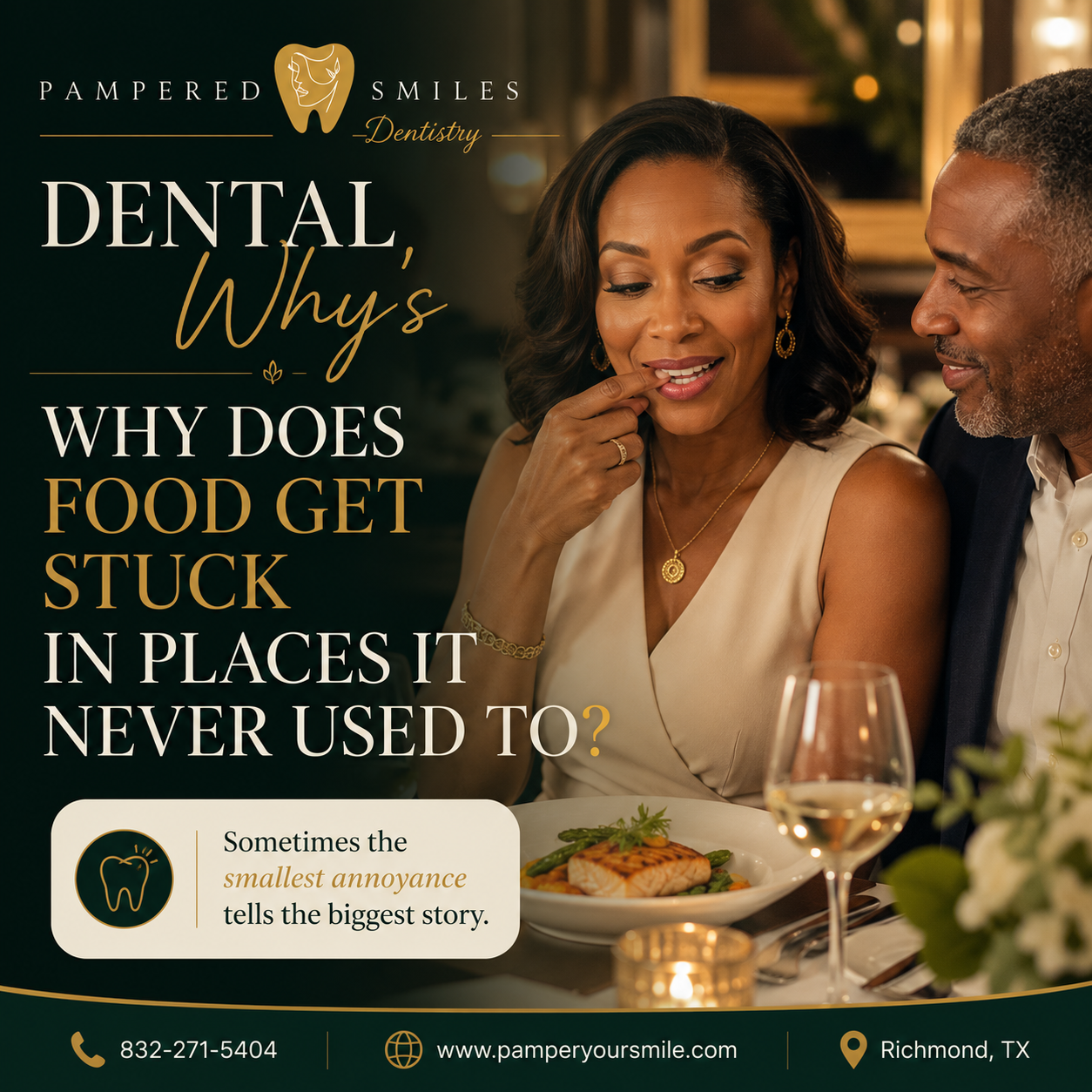
Dental Why's: Why Does Food Get Stuck in Places It Never Used To?
If food suddenly starts getting stuck between teeth where it never did before, don't ignore it. This Dental Why's explores why new food traps develop—and what they may be telling you about your oral health.
What Your Smile May Be Trying to Tell You About Aging, Tooth Movement, and Oral Health
Why Does Food Get Stuck in Places It Never Used To?
One day it happens with popcorn.
Then steak.
Then spinach.
Before long, you're reaching for a toothpick after nearly every meal.
Most people assume it's just one of those annoying parts of getting older.
But here's the Dental Why's:
Why does food get stuck in places it never used to?
In many cases, it's because something has changed.
Sometimes it's a small change.
Sometimes it's a clue that your teeth, gums, or bite are adapting in ways you haven't noticed.
Your Teeth Are Designed to Touch
Healthy teeth don't sit independently.
They gently touch the teeth beside them.
Dentists call these contact points.
Those tiny contacts are incredibly important.
They help keep food from being forced between your teeth while you chew.
When a contact changes—even slightly—food suddenly finds a new place to go.
Small Changes Can Create Big Problems
Many things can change those contact points over time.
For example:
Teeth naturally shift throughout life.
Fillings can wear down.
Teeth can become slightly worn from chewing or grinding.
A small chip can open a space.
Gum recession can expose areas that previously stayed protected.
Each change may be tiny on its own.
Together, they can create a space where food consistently becomes trapped.
Food Traps Can Lead to Bigger Issues
Getting food stuck isn't just annoying.
When food remains packed between teeth, it creates an environment where bacteria thrive.
Over time, that can increase the risk of:
Cavities between teeth
Gum inflammation
Bad breath
Tender gums
Bone loss around the teeth
Sometimes the food trap is the first symptom patients notice long before they experience pain.
Missing Teeth Change Everything
Even losing one tooth can affect neighboring teeth.
Without support, adjacent teeth may begin to drift.
Small spaces develop.
Food begins catching where it never did before.
It's one reason dentists encourage replacing missing teeth whenever possible—not simply for appearance, but to help preserve the entire bite.
Your Bite Plays a Role Too
Every time you chew, your teeth work together like gears.
When your bite changes, chewing forces change too.
Some teeth may receive more pressure than others.
Over time, that can alter the way neighboring teeth contact each other, making food traps more likely.
Often, the Solution Is Simpler Than You Think
The encouraging news is that many food traps can be improved.
Depending on the cause, treatment may include:
Replacing a worn filling
Adjusting a rough edge
Orthodontic treatment such as Invisalign®
Restoring a damaged tooth
Addressing gum disease
Replacing a missing tooth
The key is identifying why the food trap developed in the first place.
The Bigger Dental Why's
Why does food get stuck where it never used to?
Because your smile is constantly changing.
Your teeth move.
Your bite adapts.
Your gums change.
Your dental work ages.
Most of these changes happen so gradually that you never notice them—until something simple, like a piece of popcorn, begins telling you a story your smile has been writing for years.
Sometimes the smallest annoyance is also the earliest invitation to protect your long-term oral health.
People Also Ask
Why is food suddenly getting stuck between my teeth?
Food often becomes trapped because the contact between two teeth has changed due to shifting, wear, gum recession, a chipped tooth, or an aging filling.
Is it normal for food to get stuck between your teeth?
Occasionally, yes. But if it starts happening repeatedly in the same location, it's worth having your dentist evaluate the area.
Can Invisalign help stop food from getting stuck?
In some cases. If shifting teeth have created spaces that trap food, orthodontic treatment may improve those contact points.
Can food getting stuck cause cavities?
Yes. Food that remains trapped between teeth feeds bacteria, increasing the risk of cavities and gum disease if not removed.
Frequently Asked Questions
-
Yes. Consistent food trapping often means something has changed and should be evaluated.
-
A rough filling, chipped tooth, cavity, or cracked restoration may be catching the floss. text goes here
-
Yes. If a filling wears down or the contact isn't ideal, it may allow food to collect between teeth.
-
Floss is usually the safest and most effective option. Avoid using sharp objects like pins or knives, which can damage your gums.
Dental Why's: Why Doesn't Your Bite Stay the Same for Life?
Your bite isn't frozen in time. Throughout life, your teeth continue to wear, shift, and adapt. This Dental Why's explores why your bite changes over time—and why those changes matter more than you may think.
Understanding How Time Changes the Way Your Teeth Fit Together
Most people think their bite is permanent.
Once your adult teeth come in, that's simply the way they'll fit together...
Right?
Here's the Dental Why's:
Why doesn't your bite stay the same for life?
For many adults in Richmond TX and throughout Fort Bend County, the bite they have at 55 is very different from the bite they had at 25.
The change is usually so gradual that it goes unnoticed.
Until something starts to hurt.
Or crack.
Or shift.
Your Teeth Never Stop Adapting
Your teeth are alive.
They aren't cemented into your jaw like fence posts.
Instead, each tooth is suspended by a tiny ligament that allows it to respond to pressure throughout your life.
That adaptability is one of the reasons orthodontics works.
It's also why your bite continues changing long after childhood.
Every Bite Leaves a Mark
The average person swallows between 600 and 1,000 times each day.
Every swallow brings your teeth together.
Every meal.
Every snack.
Every conversation.
Over decades, those tiny contacts slowly reshape the surfaces of your teeth.
The changes are almost impossible to notice day by day—but significant over years.
Grinding Accelerates the Process
Many people clench or grind while they sleep without realizing it.
That extra pressure can lead to:
Flattened teeth
Chipped enamel
Cracks
Muscle soreness
Bite changes
Often, patients don't discover they grind until the damage has already begun.
Missing Teeth Change the Whole System
Your bite functions as a team.
When one tooth is lost, neighboring teeth begin shifting.
Opposing teeth may erupt farther than they should.
The balance of your bite slowly changes.
That's why replacing a missing tooth isn't just about appearance.
It's about protecting your entire chewing system.
Aging Dental Work Changes Your Bite Too
Fillings.
Crowns.
Bridges.
Even excellent dental work ages over time.
As restorations wear and teeth naturally change, the bite may no longer fit together exactly as it once did.
That's one reason dentists routinely evaluate your bite during comprehensive exams.
Why Invisalign Isn't Just Cosmetic
Many people associate Invisalign with straighter teeth.
But alignment is also about function.
When teeth fit together more evenly, chewing forces are distributed more predictably.
That can help reduce excessive wear on individual teeth.
For many adults, improving the bite is just as important as improving the appearance.
The Bigger Dental Why's
Why doesn't your bite stay the same for life?
Because your body is constantly adapting.
Your teeth respond to pressure.
Your muscles respond to habits.
Your jaw responds to function.
A changing bite isn't a sign that something is wrong.
It's a reminder that your smile is a living system—not a fixed structure.
The goal isn't to stop change.
It's to guide it in a healthy direction.
People Also Ask
Can your bite change as you get older?
Yes. Teeth naturally wear, shift, and adapt throughout life.
Why do my teeth suddenly feel different?
Changes in wear, grinding, missing teeth, restorations, or alignment can all affect how your bite feels.
Can Invisalign fix bite problems?
Yes. Invisalign can improve many bite issues while also straightening teeth, depending on the diagnosis.
Does grinding change your bite?
Over time, grinding can wear enamel and alter how teeth come together.
Frequently Asked Questions
-
Natural wear, shifting teeth, grinding, and dental work can all change your bite over time.
-
Yes. Teeth continue moving throughout life, although the amount varies from person to person.
-
It can contribute to muscle tension and jaw discomfort in some individuals.
-
Absolutely. Evaluating your bite is an important part of maintaining long-term oral health.
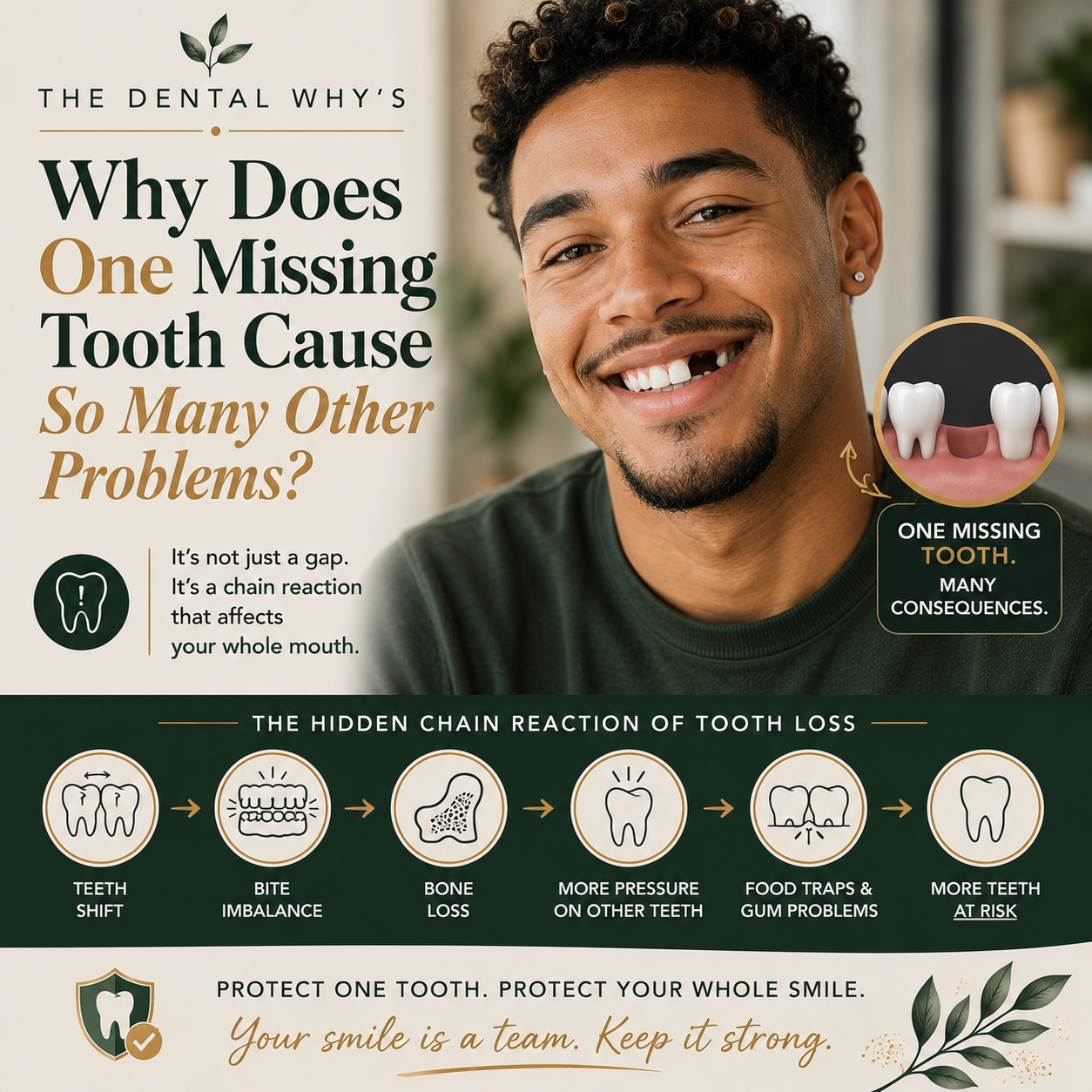
Dental Why's: Why Does One Missing Tooth Cause So Many Other Problems?
Losing one tooth may not seem like a big deal—but your mouth doesn't see it that way. This Dental Why's explores how one missing tooth can affect your entire smile over time.
The Hidden Chain Reaction of Tooth Loss in Richmond TX
"It doesn't really bother me."
That's one of the most common things dentists hear after someone loses a tooth.
Especially if it's in the back where no one can see it.
But here's the Dental Why's:
Why does one missing tooth cause so many other problems?
For many adults in Richmond TX and throughout Fort Bend County, the missing tooth isn't the biggest problem.
It's everything that happens afterward.
Your Teeth Were Designed to Work Together
Each tooth has a job.
Every bite depends on neighboring and opposing teeth sharing the workload.
When one tooth disappears, that balance changes.
Suddenly, the remaining teeth begin doing work they were never designed to do.
Teeth Don't Like Empty Space
Teeth naturally drift toward open spaces.
Over months and years they may:
Tip forward
Lean sideways
Rotate
Create new gaps
This is why patients often notice food trapping after losing a tooth.
The movement is slow—but continuous.
Your Jawbone Needs Stimulation
Teeth don't just help you chew.
Their roots stimulate the jawbone every time you bite.
Without that stimulation, the body begins removing bone from the area.
This natural process is called bone resorption.
Over time it can change:
Facial contours
Gum support
Future treatment options
More Pressure on Fewer Teeth
Imagine carrying groceries with ten people.
Now imagine carrying the same load with nine.
The work doesn't disappear.
It gets redistributed.
The same thing happens in your mouth.
The remaining teeth absorb more force, increasing the risk of:
Cracks
Worn enamel
Broken fillings
Bite problems
Missing Teeth Affect More Than Chewing
Many patients notice changes they never expected:
Speaking feels different
Confidence decreases
Food becomes harder to chew
Cleaning becomes more difficult
The effects extend beyond the empty space.
Replacing a Tooth Restores More Than Appearance
Whether through a dental implant, bridge, or another appropriate option, replacing a missing tooth helps restore:
Bite balance
Function
Bone stimulation
Tooth alignment
Long-term stability
The goal isn't simply filling a gap.
It's protecting the health of the entire mouth.
The Bigger Dental Why's
Why does one missing tooth matter so much?
Because your mouth was designed as a system.
Every tooth supports another.
When one part changes, the entire system adapts.
Sometimes those adaptations help.
Sometimes they create new problems.
Protecting one tooth often means protecting many others.
FAQ
-
Yes. Neighboring teeth can shift, altering your bite and making cleaning more difficult.
-
Yes. Without stimulation from the tooth root, the jawbone gradually loses volume.
-
Even back teeth play an important role in chewing and maintaining bite stability.
-
That depends on your oral health and goals. Common options include dental implants, bridges, and in some cases removable prosthetics.
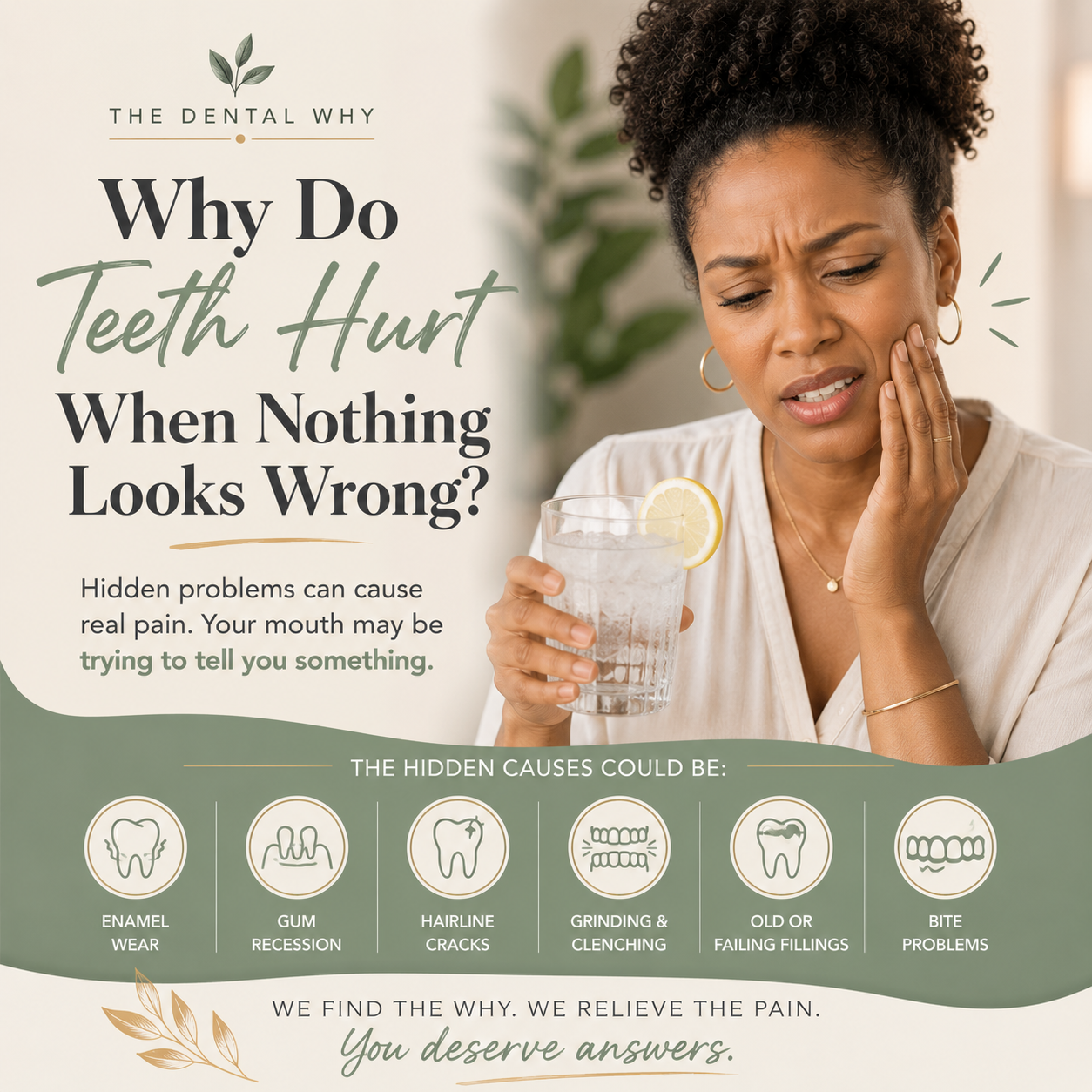
Dental Why’s: Why Do Teeth Hurt When Nothing Looks Wrong?
Sometimes tooth pain isn't caused by a visible cavity. This Dental Why explores the hidden reasons teeth become sensitive and what your mouth may be trying to tell you.
Hidden Causes of Tooth Sensitivity in Richmond TX
Sometimes tooth pain isn't caused by a visible cavity. This Dental Why explores the hidden reasons teeth become sensitive and what your mouth may be trying to tell you.
You look in the mirror.
No cavity.
No swelling.
No obvious problem.
Yet every time you drink something cold or bite into something crunchy, a sharp sensation shoots through your tooth.
Here's the Dental Why:
Why do teeth hurt when nothing appears to be wrong?
For many adults in Richmond TX and throughout Fort Bend County, tooth pain is often the first sign that something deeper is happening beneath the surface.
The mouth has a way of sending signals long before a problem becomes visible.
Enamel Doesn't Have to Be Broken to Be Sensitive
Many people assume pain means a cavity.
Sometimes it does.
But sensitivity often comes from exposed dentin—the layer beneath your enamel.
When enamel becomes thinner over time, temperature and pressure can reach the nerve more easily.
Common causes include:
Acidic foods and beverages
Teeth grinding
Aggressive brushing
Natural wear from aging
The tooth may look perfectly healthy.
But that doesn't mean it's not vulnerable.
Gum Recession Changes Everything
Healthy gums protect the roots of your teeth.
When gums recede, root surfaces become exposed.
Unlike enamel, roots are not designed to handle temperature changes and pressure.
As a result, patients may notice:
Cold sensitivity
Pain while brushing
Sharp discomfort while eating
Many adults in Fort Bend County experience gum recession gradually and don't realize it until symptoms appear.
Tiny Cracks Can Cause Big Symptoms
One of the most overlooked causes of tooth pain is a hairline crack.
These cracks are often invisible without magnification.
Yet they can cause:
Pain when biting down
Sensitivity to temperature
Random sharp sensations
The tooth may look completely normal from the outside.
But every bite places stress on the damaged area.
Grinding and Clenching Create Hidden Pressure
Many people grind their teeth at night without knowing it.
Over time, that pressure can create:
Enamel wear
Microscopic fractures
Inflamed ligaments around teeth
Tooth sensitivity
The symptoms often appear long before visible damage develops.
That's why a thorough evaluation is so important.
Old Fillings May Be Sending a Warning
Fillings don't last forever.
As restorations age, small gaps can develop between the filling and the tooth.
These gaps may allow:
Temperature changes to affect the tooth
Bacteria to enter
Increased sensitivity
For patients in Richmond TX, sensitivity is sometimes the first sign that an older filling needs attention.
Bite Problems Can Create Pain
Not all teeth absorb force evenly.
When the bite is unbalanced, certain teeth may experience more pressure than they were designed to handle.
This can lead to:
Tooth soreness
Sensitivity while chewing
Cracks over time
Accelerated wear
Sometimes the problem isn't the tooth itself.
It's how the teeth work together.
The Bigger Dental Why
Why does pain show up before we can see the problem?
Because pain is often the body's early warning system.
Your mouth is designed to communicate when something needs attention.
Ignoring those signals doesn't make them disappear.
It usually allows the underlying cause to progress.
When a tooth hurts, even when everything looks fine, it's worth listening.
Frequently Asked Questions
-
Sensitivity can be caused by gum recession, enamel wear, cracks, grinding, bite problems, or aging dental work.
-
Yes. Hairline cracks are often too small to see but can still cause significant symptoms.
-
Cold sensitivity often occurs when dentin becomes exposed through enamel wear or gum recession.
-
Yes. Stress often contributes to grinding and clenching, which can create tooth sensitivity and soreness.
-
If sensitivity is persistent, worsening, or affecting your ability to eat and drink comfortably, it should be evaluated.
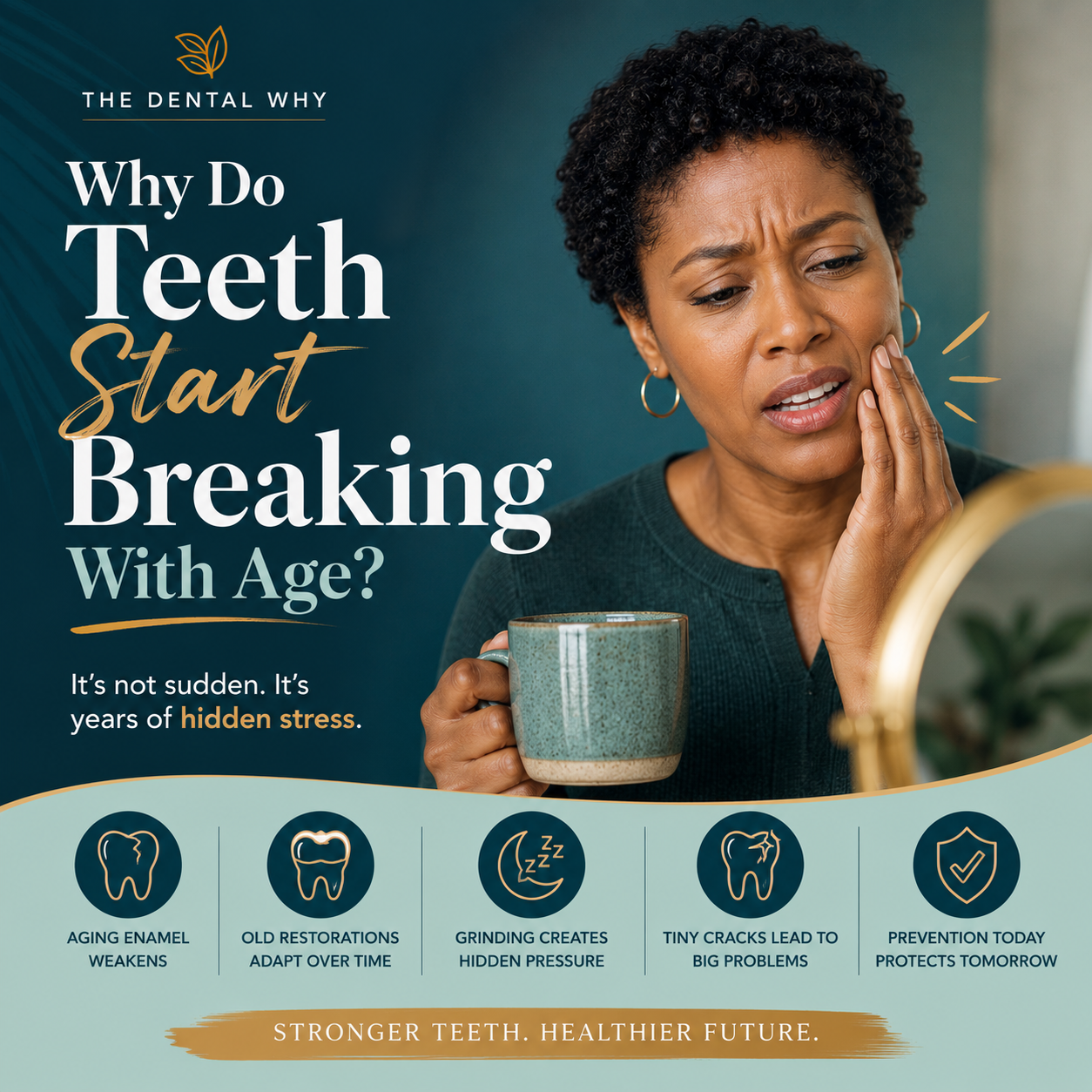
Dental Why’s: Why Do Teeth Suddenly Start Breaking As We Get Older?
Teeth rarely break “out of nowhere.” This Dental Why explores how aging enamel, grinding, bite stress, and old dental work slowly weaken teeth over time.
Cracked Teeth in Richmond TX and the Hidden Effects of Time
One day it’s fine.
Then suddenly:
A corner breaks.
A tooth cracks.
Something feels sharp when you chew.
Here’s the Dental Why:
Why do teeth seem to break more as we get older?
For many adults in Richmond TX and throughout Fort Bend County, the issue isn’t one bad bite.
It’s years of accumulated stress.
Teeth Age Like Everything Else
Teeth are incredibly strong.
But they are not indestructible.
Over time, enamel experiences:
Pressure
Temperature changes
Acid exposure
Grinding forces
Wear from chewing
Years of stress gradually weaken the structure.
Old Dental Work Changes the Equation
Large fillings, crowns, and previous dental work can alter how force travels through a tooth.
Especially:
Silver fillings
Large restorations
Teeth with previous fractures
As natural tooth structure decreases, the remaining enamel becomes more vulnerable.
Grinding Often Happens Without Realizing It
Many adults clench or grind at night without knowing.
That repeated pressure can create:
Micro-cracks
Flattened teeth
Sensitivity
Fractures over time
For many patients in Fort Bend County, the problem builds silently for years.
Why Teeth Often Break “Suddenly”
Most cracks are not sudden.
The final break is.
The weakening process often happens gradually until one moment becomes the tipping point:
Biting ice
Crunching hard bread
Eating popcorn
Grinding overnight
The break feels immediate.
The stress was long-term.
What Can Help Protect Teeth
For patients in Richmond TX, prevention may include:
Replacing failing restorations
Bite adjustment
Nightguards for grinding
Invisalign to improve force distribution
Crowns or onlays for weakened teeth
The goal is not just repair.
It’s reinforcement.
The Bigger Dental Why
Why do we treat cracked teeth like accidents?
Most of the time, they’re signals.
The mouth adapts quietly for years before it reaches a limit.
Teeth don’t usually fail overnight.
They fail gradually… until they can’t compensate anymore.
Frequently Asked Questions About Cracked Teeth
-
Years of pressure, grinding, aging enamel, and old restorations weaken teeth over time.
-
Yes. Chronic clenching and grinding create repeated stress that contributes to fractures.
-
No. Some cracks remain symptom-free until they worsen.
-
In some cases, improving bite alignment can reduce uneven pressure on teeth.
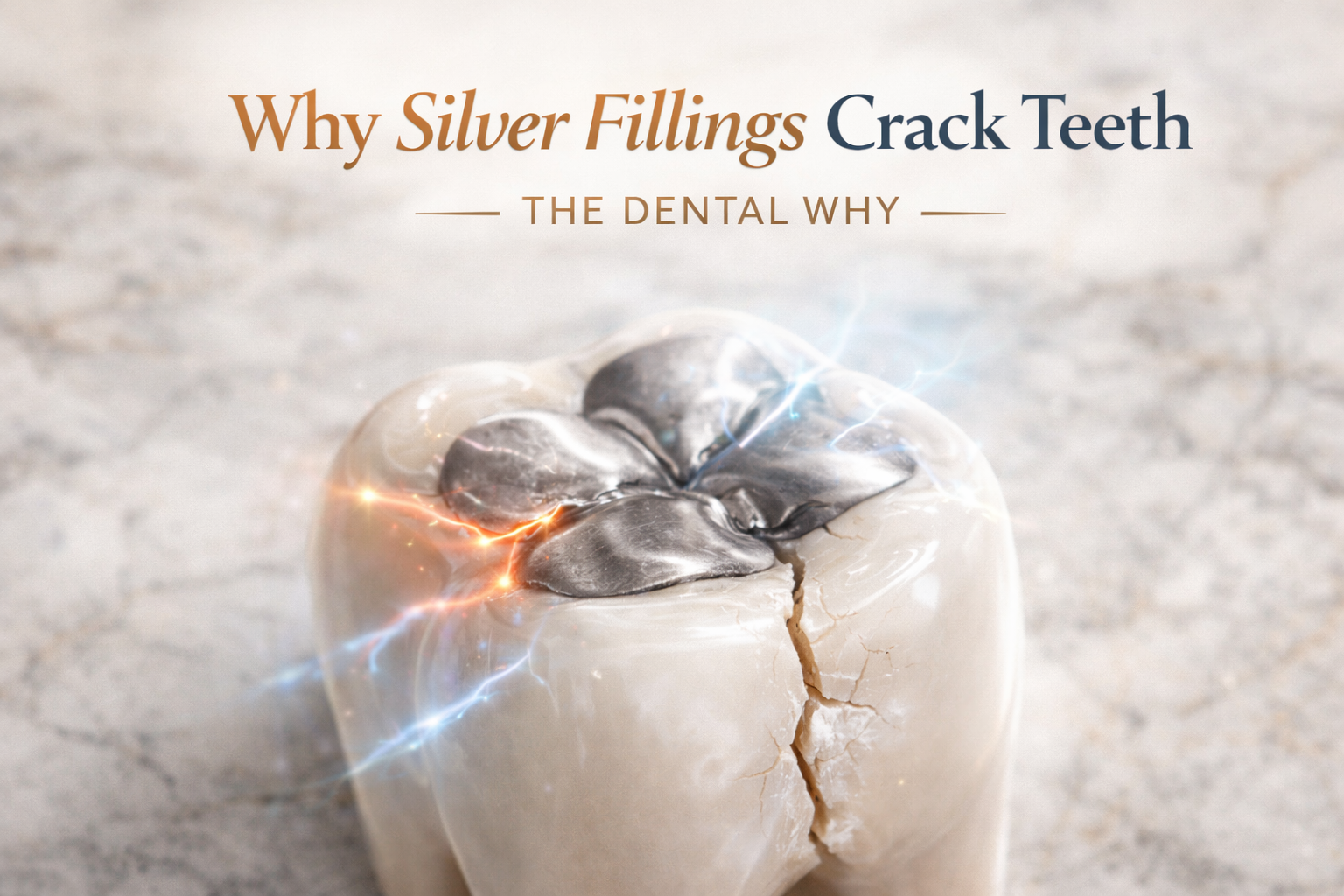
Dental Why’s: Why Are Silver Fillings Acting Like a Thermometer Cracking Your Teeth?
Silver fillings don’t just sit in your teeth — they react to temperature. Over time, that expansion and contraction can create pressure that weakens and cracks natural tooth structure.
Mercury Fillings in Richmond TX and the Hidden Risk of Temperature Expansion
Most people think of silver fillings as stable.
Durable.
Long-lasting.
“Set it and forget it.”
But here’s the Dental Why:
Why do so many teeth with old silver fillings end up cracked?
For many patients in Richmond TX and throughout Fort Bend County, the issue isn’t decay.
It’s physics.
Silver Fillings Don’t Stay Still
Silver (amalgam) fillings respond to temperature.
Hot coffee.
Cold water.
Ice.
Soup.
Each time your mouth shifts temperature, the metal filling expands and contracts.
Teeth don’t.
That difference creates internal stress.
Over time, that stress adds up.
The Thermometer Effect Inside Your Tooth
Think of a thermometer.
When temperature changes, the material inside expands and contracts.
Silver fillings behave the same way — but inside a rigid structure.
Your tooth.
Every cycle creates micro-pressure along the walls of the tooth.
Eventually, that pressure can lead to:
Hairline fractures
Cracked cusps
Structural weakening
Sudden tooth breaks while chewing
Many patients don’t feel anything — until something gives.
Why Cracks Often Go Undetected
Cracks don’t always hurt right away.
In fact, many patients in Fort Bend County are surprised when:
A tooth fractures suddenly
Pain appears when biting
Sensitivity increases without warning
By the time symptoms show up, the damage has often progressed.
That’s why early evaluation matters.
Why Many Patients in Richmond TX Replace Silver Fillings
Modern dentistry offers more stable alternatives.
Tooth-colored fillings and bonded restorations:
Do not expand like metal
Bond to natural tooth structure
Reinforce weakened teeth
Reduce internal stress
For larger fillings, porcelain onlays or crowns may be recommended to protect the tooth long-term.
The goal isn’t just to replace a filling.
It’s to preserve the tooth.
When Should a Silver Filling Be Replaced?
Not every silver filling needs immediate removal.
But evaluation is important if you have:
Large or aging fillings
Visible cracks or lines in the tooth
Sensitivity to temperature
Pain when biting
In Richmond TX, many patients choose proactive replacement before fractures occur.
Because prevention is simpler than repair.
The Bigger Dental Why
Why do materials that were designed to restore teeth sometimes contribute to their breakdown?
Because not all materials behave like natural biology.
Teeth are rigid, but slightly flexible.
Metal is reactive.
When those two systems don’t match, stress builds.
Silver fillings aren’t inherently bad.
But over time, they can work against the tooth they were meant to protect.
Frequently Asked Questions About Silver Fillings
-
They can contribute to cracking over time due to expansion and contraction from temperature changes.
-
They are still considered safe, but many patients choose to replace them due to structural concerns rather than toxicity.
-
Not always. A dentist should evaluate each filling individually based on size, age, and risk.
-
Tooth-colored composite or porcelain restorations are commonly used because they bond to the tooth and don’t expand like metal.