

Dental Education & Cosmetic Insights in Richmond TX
Our dental blog shares expert insights on Invisalign, smile makeovers, veneers, and preventive care for patients in Richmond TX and throughout Fort Bend County. We believe informed patients make confident decisions about their oral health.
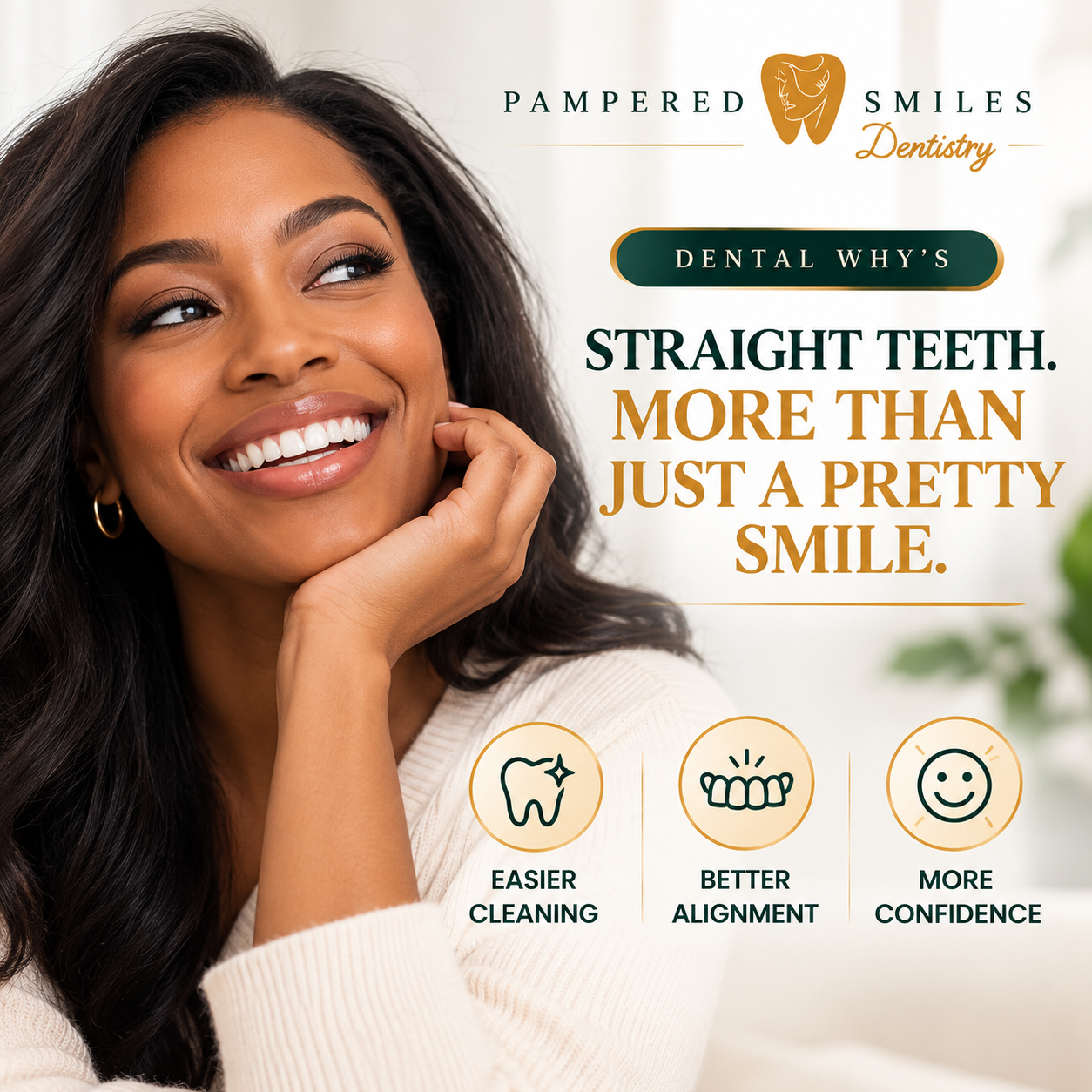
Is Straightening Your Teeth Really Just Cosmetic?
A straighter smile can look beautiful, but is that the only reason to consider orthodontic treatment? Discover how tooth alignment may influence oral hygiene, bite function, t
Why a straighter smile may be about more than what you see in the mirror.
Let's be honest.
When most people think about straightening their teeth, they think about one thing:
A prettier smile.
They imagine taking pictures without hiding their teeth.
Smiling confidently in a room full of people.
Looking in the mirror and finally loving what they see.
And there's absolutely nothing wrong with that.
Wanting to feel good about your smile is a perfectly valid reason to explore orthodontic treatment.
But here's something many people don't realize.
The way your teeth are positioned can affect more than your appearance.
Your teeth are designed to work together.
They help you chew.
They influence how your bite comes together.
Their positions can affect how easily you clean certain surfaces.
And when teeth are crowded, rotated, or positioned in ways that interfere with function, the consequences may go beyond aesthetics.
So this week's Dental Why's asks:
Is straightening your teeth really just cosmetic?
The answer is no—not always.
And understanding why may change the way you think about orthodontic treatment.
1. Your Teeth Aren't Just for Smiling
Think about how often you use your teeth in a single day.
You bite into breakfast.
You chew lunch.
You speak during conversations.
You swallow.
You smile.
Your teeth participate in an impressive number of everyday activities.
But they're not designed to function independently.
They're part of a coordinated system involving your jaw muscles, jaw joints, gums, supporting bone, and surrounding tissues.
When your teeth come together, that relationship is called your occlusion, or bite.
Ideally, your bite should allow your teeth to function comfortably and efficiently.
But some alignment problems can interfere with that relationship.
For example, certain teeth may contact too early, or a tooth may be positioned in a way that creates an unfavorable biting pattern.
Not every crooked tooth causes a functional problem.
And not every imperfect bite needs treatment.
But in some cases, correcting alignment can improve how the teeth work together.
That's not just cosmetic. That's functional dentistry.
2. Crowded Teeth Can Make Cleaning More Difficult
Here's a question worth asking:
Have you ever tried flossing between two teeth that overlap?
Sometimes the floss barely fits.
Other times, the contact is so awkward that you have to maneuver around the teeth just to reach the area.
And brushing?
A toothbrush can only clean the surfaces its bristles can effectively reach.
When teeth are crowded or rotated, certain areas may be harder to access.
That can make plaque removal more challenging.
And when plaque isn't consistently removed, the risk of problems like cavities and gum inflammation can increase.
Now, does that mean everyone with crooked teeth will develop cavities or gum disease?
Absolutely not.
Many people maintain excellent oral health despite significant crowding.
And straight teeth can still develop cavities and gum disease if they're not properly cared for.
But for some patients, improving alignment can make daily oral hygiene more manageable.
Imagine going from struggling to thread floss around overlapping teeth to having more accessible spaces between them.
That can make a meaningful difference in your daily routine.
Straighter teeth don't replace good oral hygiene. They may make good oral hygiene easier.
3. Your Bite Can Influence How Your Teeth Wear
Your teeth are incredibly strong.
But they're not indestructible.
Every time you chew, your teeth experience forces.
Over time, normal chewing produces some wear.
However, certain bite relationships may contribute to uneven contact patterns or localized tooth wear.
For example, a tooth that sits outside its ideal position may experience contact differently from neighboring teeth.
In some situations, correcting that relationship may help distribute biting forces more favorably.
But there's an important distinction.
Not all tooth wear is caused by crooked teeth.
Grinding, clenching, acidic foods and drinks, and other factors can also contribute to wear.
And orthodontic treatment doesn't automatically prevent grinding or eliminate every cause of tooth damage.
That's why a comprehensive dental evaluation is important.
Before recommending Invisalign, we want to understand what's actually happening in your mouth.
Are your teeth crowded?
Is your bite contributing to a problem?
Are there signs of grinding?
Are your gums healthy?
The answers help determine whether orthodontic treatment could offer functional benefits.
4. Sometimes It's About Protecting Your Gums, Too
Your gums and supporting bone are essential to keeping your teeth healthy.
And tooth position can sometimes influence the relationship between a tooth and its surrounding tissues.
For example, a tooth positioned significantly outside the ideal arch may have different gum and bone support characteristics than a properly positioned tooth.
In selected cases, orthodontic treatment may help improve tooth positioning within the dental arch.
But this is also an area where careful planning matters.
Moving teeth without considering gum health, bone support, and periodontal risk factors can create problems rather than solve them.
That's why patients with gum disease or reduced bone support may need periodontal treatment or additional evaluation before beginning orthodontics.
Healthy tooth movement requires healthy supporting tissues.
And that's another reason Invisalign should be approached as professional dental treatment—not simply a cosmetic product.
5. Confidence Matters More Than We Sometimes Admit
Now let's talk about something that doesn't show up on a dental X-ray.
Confidence.
Maybe you cover your mouth when you laugh.
Maybe you avoid smiling in photographs.
Maybe there's one tooth you've been self-conscious about for years.
Or maybe you've simply always wanted to feel more comfortable with your smile.
Those feelings are personal.
And they matter.
A person's smile can play a role in how they feel during social interactions, professional conversations, and everyday life.
For some patients, orthodontic treatment brings a meaningful improvement in smile satisfaction and confidence.
But confidence is individual.
Straightening teeth doesn't guarantee happiness, professional success, or improved self-esteem.
And you don't need perfectly aligned teeth to have a beautiful smile.
Still, when someone chooses treatment because they want to feel more comfortable smiling, that goal deserves to be taken seriously.
Cosmetic benefits aren't superficial simply because they're visible.
Sometimes the value of treatment is both physical and personal.
6. Does Everyone With Crooked Teeth Need Invisalign?
No.
And this is one of the most important things we can tell our patients.
Crooked teeth don't automatically mean unhealthy teeth.
Some alignment differences are primarily cosmetic.
Others may create cleaning challenges or functional concerns.
And some may not require treatment at all.
The decision depends on several factors, including:
The severity and type of crowding or spacing
How your upper and lower teeth fit together
Your gum and bone health
Whether alignment contributes to cleaning or functional problems
Your personal smile goals
Whether Invisalign is appropriate for the movements needed
The purpose of an Invisalign consultation isn't simply to tell everyone they need aligners.
It's to determine whether treatment makes sense for their individual situation.
And if treatment is appropriate, what approach offers the best balance of health, function, appearance, and predictability.
7. Invisalign Isn't Just About Making Teeth Look Straight
Last week, we explored how Invisalign uses controlled orthodontic forces and your body's natural bone-remodeling process to gradually move teeth.
But the goal of treatment isn't always limited to making the front teeth look more even.
Depending on the case, Invisalign may be used to address:
Crowding: Creating a more favorable arrangement of overlapping or rotated teeth.
Spacing: Closing selected gaps between teeth.
Certain bite discrepancies: Improving specific relationships between the upper and lower teeth.
Tooth positioning: Moving teeth toward planned positions that may support improved function or hygiene access.
Of course, not every case can be treated predictably with clear aligners alone.
Some patients may benefit more from traditional braces, other orthodontic appliances, or specialist care.
And every treatment plan should be individualized.
That's what makes a professional evaluation so important.
8. What About Patients Who Have Lived With Crooked Teeth for Years?
This is a question we hear often.
"I've had crooked teeth my whole life. Is it too late to straighten them?"
Not necessarily.
Adults can undergo orthodontic treatment because the biological process that allows teeth to move continues beyond childhood.
As we discussed in Week 2, your teeth are supported by living tissues that respond to carefully controlled forces.
However, adult treatment planning must account for existing restorations, gum health, bone support, and other dental conditions.
Age alone doesn't determine whether someone is a good Invisalign candidate.
Their overall oral health and specific orthodontic needs matter more.
So if you've spent years assuming that orthodontic treatment was only for teenagers, it may be worth having a conversation.
You might have more options than you realize.
The Bigger Dental Why's
So, is straightening your teeth really just cosmetic?
Sometimes the primary benefit is cosmetic.
And that's perfectly valid.
But in other cases, improving tooth alignment can also support better access for oral hygiene, address certain bite problems, or improve how teeth function together.
A straighter smile may be easier to clean.
It may help correct a problematic bite.
It may contribute to more favorable tooth contacts.
And it may help someone feel more confident showing their smile.
But none of these outcomes should be assumed for every patient.
The real value of orthodontic treatment isn't simply making teeth look different. It's understanding whether changing their position can improve something meaningful for you.
And that's the Dental Why's.
Your smile isn't just something people see.
It's something you use every single day.
Your Smile Deserves More Than a One-Size-Fits-All Answer
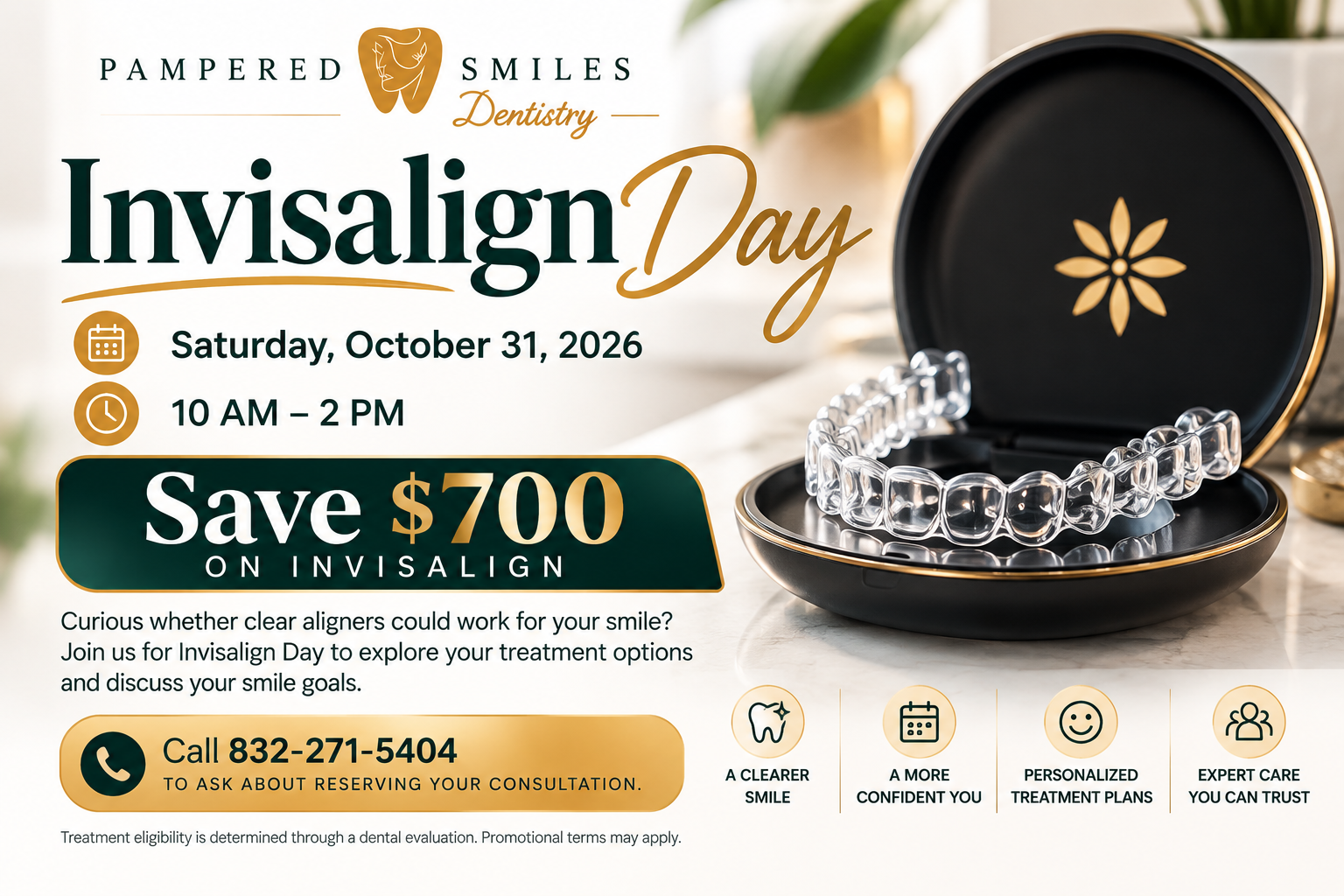
Whether you're interested in improving your smile's appearance, exploring a bite concern, or simply learning about your options, Invisalign Day is an opportunity to start the conversation.
Discover whether clear aligners may be right for you.
Call 832-271-5404 to ask about reserving your consultation.
Treatment eligibility is determined through a dental evaluation. Promotional terms may apply.
Frequently Asked Questions
-
Not automatically. Straight teeth can still develop cavities and gum disease, while many people with crooked teeth maintain excellent oral health. However, improving certain alignment problems may make cleaning easier or address specific functional concerns.
-
Yes, Invisalign can correct certain bite problems, depending on their complexity. Some bite discrepancies may require other orthodontic approaches or additional treatment.
-
No. Invisalign does not directly prevent cavities. Correcting certain crowding problems may improve access for brushing and flossing, but daily hygiene, diet, fluoride exposure, and preventive dental care remain essential.
-
Crooked teeth do not directly cause gum disease. However, crowded or rotated teeth can make plaque removal more challenging, which may contribute to gum inflammation when oral hygiene is inadequate.
-
Invisalign is not a treatment for every cause of grinding or clenching. Although correcting certain bite problems may be appropriate for some patients, orthodontic treatment should not be expected to cure bruxism.
-
That depends on your goals, oral health, and treatment needs. For some patients, a minor cosmetic improvement is meaningful. Others may prefer not to pursue treatment. A consultation can help clarify the potential benefits and limitations.
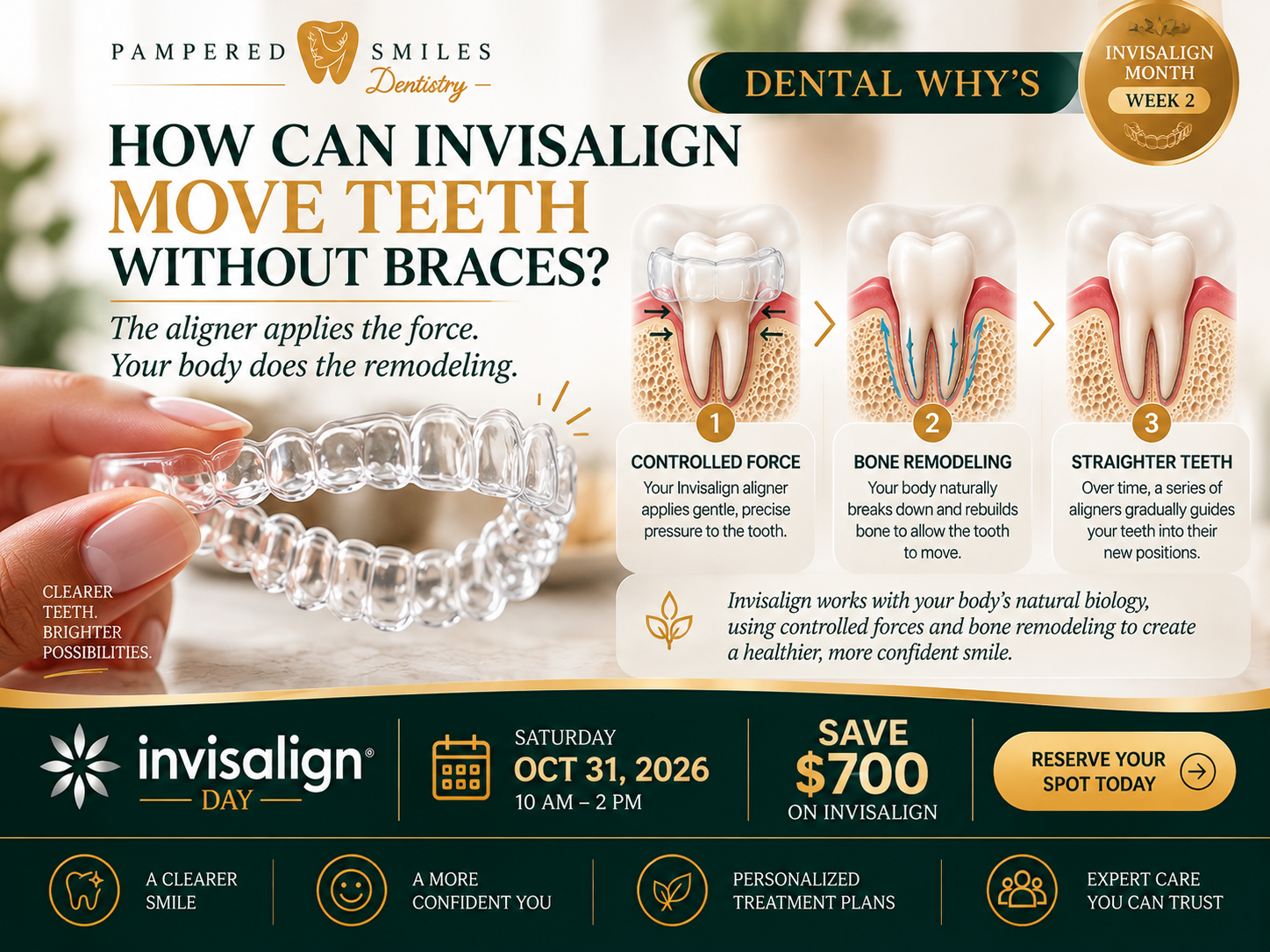
Dental Why’s: How Can Invisalign Move Teeth Without Braces?
Invisalign aligners may look like simple transparent trays, but the science behind them is anything but simple. Discover how controlled pressure, living bone, and your body's natural remodeling process work together to gradually straighten teeth.
You’ve probably seen them.
Those nearly invisible plastic trays that fit over someone's teeth.
No brackets.
No wires.
No colorful rubber bands.
Just clear plastic.
And somehow...
Teeth actually move.
If you've ever looked at an Invisalign aligner and wondered how something so thin could possibly straighten a crooked smile, you're asking a very good question.
Because the answer isn't simply that plastic pushes teeth around.
It's much more fascinating than that.
Here's the Dental Why's:
How can Invisalign move teeth without braces?
Because your teeth aren't permanently fused into your jawbone.
They're part of a living biological system capable of responding to carefully controlled forces.
And Invisalign works with that system.
Your Teeth Are More Mobile Than You Think
When you look in the mirror, your teeth appear completely stationary.
They feel solid.
And under normal circumstances, they should.
But your teeth aren't embedded directly into your jawbone like nails in a piece of wood.
Each natural tooth is suspended within its socket by a specialized network of connective tissue called the periodontal ligament, or PDL.
This thin ligament connects the tooth root to the surrounding bone.
It helps absorb chewing forces.
It provides sensory feedback.
And it plays an important role in how teeth respond to orthodontic treatment.
Remember our September Dental Why's about how your teeth know when something is too hard?
This is the very same ligament.
But now we're exploring another one of its remarkable abilities.
It helps make tooth movement possible.
Your Jawbone Is Alive—and Constantly Changing
Most people imagine bone as something rigid and unchanging.
But bone is living tissue.
Throughout your life, your body continuously breaks down and rebuilds small amounts of bone.
This process is called bone remodeling.
Two important types of cells participate:
Osteoclasts: Cells that break down bone.
Osteoblasts: Cells that form new bone.
These cells work together to help maintain and adapt your skeleton.
And orthodontic treatment takes advantage of this natural biological process.
What Happens When an Aligner Applies Pressure?
Imagine a tooth that needs to move slightly to the right.
Your Invisalign aligner is designed to apply controlled forces that encourage that movement.
Those forces are transmitted through the tooth to the periodontal ligament and surrounding bone.
The tissues respond.
Bone remodeling occurs around the tooth, allowing its position to change gradually.
This doesn't happen instantly.
And it isn't simply the tooth being pushed through solid bone.
Your body is actively participating in the movement.
That's the science behind orthodontics.
The aligner provides the mechanical force.
Your biology makes the movement possible.
Why Do You Need Multiple Aligners?
Here's another question patients often ask:
"Why can't I just wear one aligner until my teeth are straight?"
Because each aligner is designed to accomplish a limited amount of planned movement.
Think of it like taking a long road trip.
You don't teleport from Houston to California.
You travel through a series of smaller distances.
Invisalign treatment works through a planned sequence of aligners.
Each aligner is shaped to encourage specific tooth movements.
As your teeth progress, you move to the next aligner in the series according to your prescribed schedule.
Over time, those individual movements can add up to meaningful changes in alignment.
And that's why the order matters.
You can't safely skip ahead simply because you want faster results.
Why Does Invisalign Sometimes Feel Tight?
If you've ever worn Invisalign, you may remember putting in a new set of aligners and feeling pressure.
That sensation is often expected.
The new aligner is designed for the next stage of planned movement.
Because your teeth haven't yet reached that position, the aligner applies force as it fits over them.
Some temporary pressure or tenderness may occur as your teeth and surrounding tissues respond.
But there's an important distinction.
Pressure is not the same as severe pain.
Significant or persistent pain, an aligner that doesn't fit properly, or unusual symptoms should be discussed with your dentist.
Orthodontic treatment should be carefully monitored, not endured blindly.
What Are Those Little Bumps on Invisalign Teeth?
This is one of my favorite parts of the science.
Patients sometimes notice that Invisalign treatment includes small, tooth-colored shapes bonded to certain teeth.
These are called attachments.
And no, they're not decorative.
Attachments help the aligner grip the teeth and apply forces more effectively for certain movements.
Think about trying to pick up a smooth, wet bar of soap.
It's difficult to control.
Now imagine the soap had a small handle.
Suddenly, you have a better way to guide it.
Attachments serve a somewhat similar purpose.
They help the aligner achieve certain planned tooth movements that might be difficult with a smooth tooth surface alone.
Not everyone needs the same attachments.
Their placement depends on the treatment plan.
So Why Do Patients Need to Wear Invisalign 20–22 Hours a Day?
Because tooth movement requires consistent application of the planned forces.
Invisalign aligners are generally prescribed for 20–22 hours of daily wear, although patients should follow their dentist's specific instructions.
That means removing them primarily for meals, drinks other than water, and oral hygiene.
When aligners are left out for extended periods, treatment may not progress as planned.
Your teeth may not track properly with the next aligner.
And additional adjustments or refinements may become necessary.
This is one reason patient participation is so important.
Your dentist creates the plan. Your consistency helps make the plan work.
Is Invisalign Really Different From Traditional Braces?
Yes—and no.
The biological foundation is the same.
Both traditional braces and clear aligners use orthodontic forces to encourage tooth movement through bone remodeling.
The main difference is how those forces are delivered.
Traditional braces use brackets and wires attached to the teeth.
Invisalign uses a sequence of removable, custom-designed clear aligners, sometimes assisted by attachments and other orthodontic components.
Each system has advantages and limitations.
Some movements or complex cases may be more predictable with braces or other orthodontic approaches.
The best treatment depends on the individual patient's needs.
That's why a proper evaluation matters.
Why Can't We Just Move Teeth Faster?
This is where biology reminds us that faster isn't always better.
Orthodontic movement involves living tissues.
The periodontal ligament and surrounding bone need time to respond.
Applying excessive force doesn't necessarily produce faster or healthier movement.
In fact, inappropriate orthodontic forces can increase the risk of complications, including root resorption and damage to supporting tissues.
That's why Invisalign treatment is carefully planned and monitored.
The goal isn't simply to make teeth move.
The goal is to move them in a controlled, healthy, and predictable way.
And this is something we'll explore more deeply in our final October Dental Why's.
What Happens After Your Teeth Are Straight?
Here's something that surprises patients:
Finishing your aligners doesn't mean your teeth can never move again.
Remember Week 1?
Your teeth exist in a living environment.
They can shift throughout your life.
Even after orthodontic treatment, surrounding tissues and everyday forces can influence tooth position.
That's why retainers are essential.
Retention helps maintain the alignment achieved during treatment.
Straightening your teeth is the active phase.
Keeping them straight is the lifelong commitment.
The Bigger Dental Why's
How can Invisalign move teeth without braces?
Because your teeth are not static objects.
They're connected to living tissues.
Your periodontal ligament responds to force.
Your bone remodels.
Your body adapts.
And carefully designed aligners help guide that natural biological process toward a planned result.
The technology may look simple.
The biology is anything but.
Invisalign doesn't just move teeth. It works with your body's remarkable ability to change.
And that's one more reason your smile is more fascinating than it looks.
Thinking About Invisalign?
People Also Ask / FAQ
-
Yes. Orthodontic treatment is intended to move teeth, including their roots, through the surrounding bone. The exact movement depends on the treatment plan and how the tissues respond.
-
Orthodontic forces begin acting when aligners are worn, but noticeable changes generally develop gradually over weeks and months. The timeline varies with the complexity of the case.
-
Attachments provide additional surfaces for aligners to engage, helping deliver the forces needed for certain tooth movements.
-
Invisalign can effectively treat many orthodontic problems. Traditional braces or other approaches may be more suitable for some complex movements or bite corrections.
-
Inconsistent wear can cause teeth to fall behind the planned sequence of movements, affect aligner fit, and potentially extend treatment.
-
They can. That's why wearing retainers as prescribed is essential to maintaining your results.
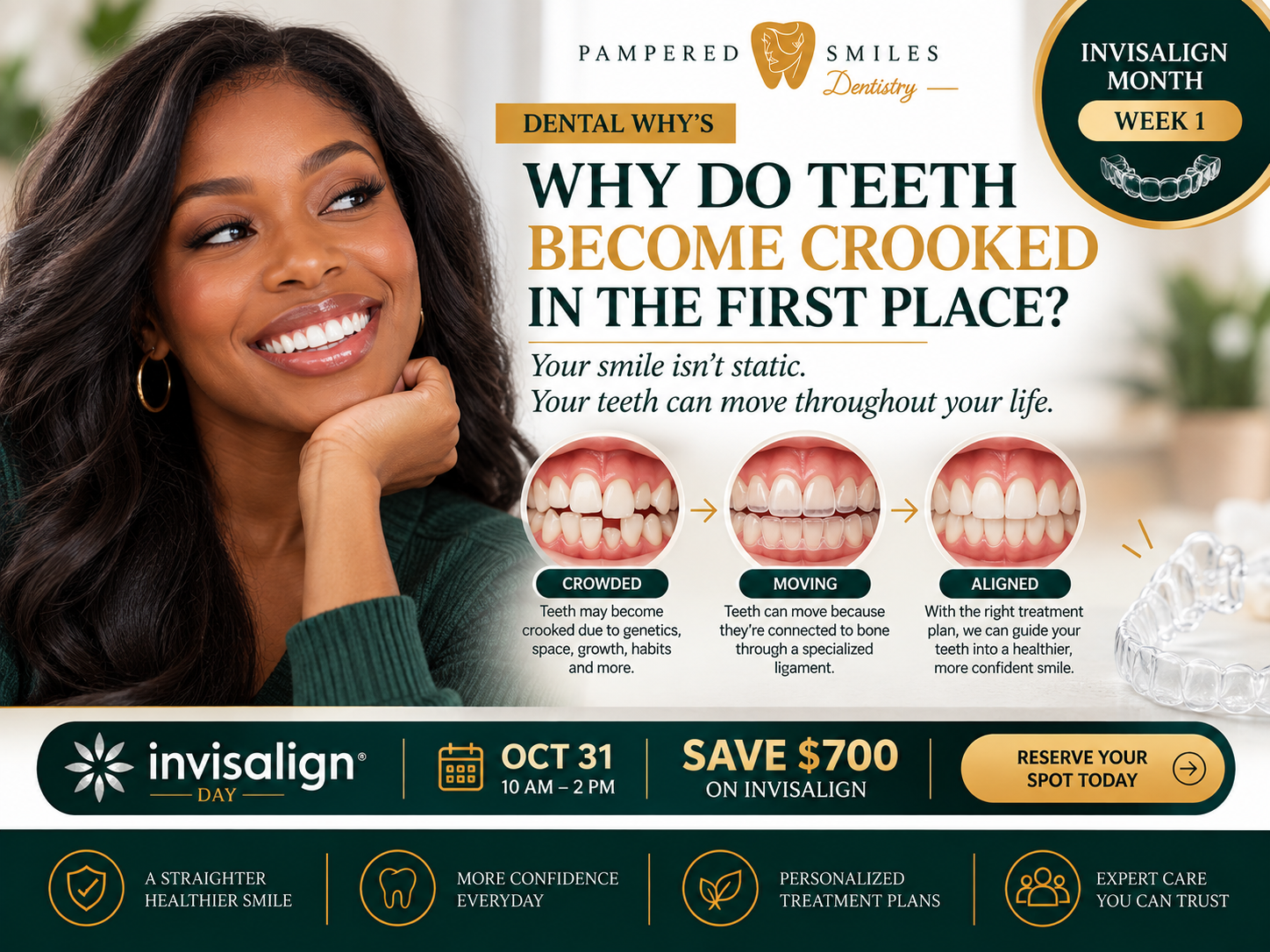
Dental Why’s: Why Do Teeth Become Crooked in the First Place?
Why do some people naturally have straight teeth while others develop crowding, gaps, or overlapping teeth? And why can teeth that were once straight begin shifting later in life? The answer involves much more than genetics.
Your Teeth Didn’t Necessarily Start That Way—and They May Not Stay Where They Are
Look at almost any childhood photo.
There may be gaps.
Tiny teeth.
Teeth coming in at strange angles.
Maybe one front tooth seemed determined to arrive before everyone else.
Eventually, most of us develop a full adult smile.
But why do some people's teeth line up beautifully while others become crowded, rotated, spaced, or overlapping?
And here's an even more interesting question:
Why can teeth that used to be straight become crooked later?
Here's the Dental Why's:
Why do teeth become crooked in the first place?
There isn't one answer.
Your tooth alignment is the result of a surprisingly complex relationship between your teeth, jaws, genetics, growth, habits, surrounding tissues—and time.
Your smile isn't assembled like a row of perfectly placed tiles.
It's part of a living, changing biological system.
Your Teeth Need Somewhere to Go
Let's start with one of the simplest explanations for crowding:
Space.
Your adult teeth have a certain size.
Your jaws provide a certain amount of room.
If the amount of space available doesn't match the amount of space your teeth need, something has to give.
Imagine trying to seat ten people comfortably at a table designed for eight.
Everyone may fit...
but not necessarily in a perfect row.
Teeth can respond similarly.
They may rotate.
Overlap.
Erupt slightly forward or backward.
This is one reason dental crowding can develop.
So Is Crookedness Genetic?
Genetics can absolutely influence your smile—but not quite as simply as inheriting "crooked teeth."
You inherit characteristics that affect dental development.
That can include aspects of:
Tooth size
Jaw size and shape
Facial growth patterns
Spacing
Bite relationships
And those characteristics don't necessarily arrive as one perfectly matched package.
Your teeth and jaws develop through a combination of inherited traits and environmental influences.
So yes, family resemblance can show up in your smile.
But genetics aren't the entire story.
Baby Teeth Have an Important Job
Baby teeth aren't simply disposable starter teeth.
They help preserve space for the permanent teeth developing beneath them.
When a baby tooth is lost significantly earlier than expected, neighboring teeth may sometimes move into that space.
That can reduce the room available for the permanent tooth that's supposed to erupt later.
This is one reason dentists pay attention to when children lose baby teeth—not just whether they lose them.
Those little teeth are helping manage real estate.
Your Habits Can Influence Development Too
During childhood, the jaws and facial structures are still developing.
Certain prolonged oral habits can influence that development.
Depending on their duration and intensity, habits such as prolonged thumb or finger sucking may affect the position of teeth or the way the upper and lower teeth come together.
This doesn't mean every childhood habit creates an orthodontic problem.
Duration, frequency, intensity, age, growth patterns and genetics all matter.
But it illustrates something important:
Your teeth don't develop in isolation.
They respond to the environment around them.
Your Tongue, Lips and Cheeks Are Part of the Equation
Even when you're sitting perfectly still, forces are acting on your teeth.
Your tongue applies pressure from inside.
Your lips and cheeks apply pressure from outside.
When these forces are balanced, they help contribute to the environment in which your teeth function.
Changes in muscle patterns, oral habits, growth and tooth position can influence that balance.
Once again, your smile is not a static structure.
It's biological.
Why Do Teeth Shift as Adults?
Now we get to the part that surprises many patients.
Maybe you had braces as a teenager.
Your teeth looked fantastic.
Years later, you look in the mirror and think:
"Wait... was that tooth always there?"
Maybe the lower front teeth seem more crowded.
Maybe a small space has appeared.
Maybe something looks slightly rotated.
Adult teeth can change position over time.
Your teeth exist in a living environment influenced by forces from chewing, lips, cheeks, tongue, periodontal tissues and changes that occur throughout life.
This is one reason retainers matter after orthodontic treatment.
Moving teeth is only part of orthodontics.
Keeping them where we put them matters too.
Do Wisdom Teeth Make Your Front Teeth Crooked?
This is one of those dental ideas that gets repeated constantly.
"My wisdom teeth pushed all my teeth forward."
The relationship isn't that simple.
Late crowding—particularly of the lower front teeth—can occur during the same years that wisdom teeth develop or erupt.
That timing makes wisdom teeth an easy suspect.
But changes in tooth alignment can occur for multiple reasons, including normal growth and changes in the supporting structures around the teeth.
Removing wisdom teeth solely to prevent future front-tooth crowding isn't a guaranteed solution.
Your dentist evaluates wisdom teeth based on their own health, position and potential risks.
What Happens When a Tooth Is Missing?
Here's another reason teeth can shift:
An empty space.
When a permanent tooth is lost, the surrounding teeth may gradually change position.
A neighboring tooth may tilt toward the space.
The opposing tooth may move because its normal contact has changed.
The bite can begin changing.
This connects to something we've discussed before in Dental Why's:
A missing tooth isn't always just an empty space.
The rest of the mouth notices.
Are Crooked Teeth Unhealthy?
Not automatically.
This distinction matters.
Perfectly straight teeth are not a requirement for a healthy mouth.
And orthodontic treatment isn't medically necessary simply because a smile doesn't look perfectly symmetrical.
However, certain alignment or bite problems can make oral hygiene more difficult, contribute to uneven wear, or affect how the teeth function together.
The question shouldn't simply be:
"Are my teeth perfectly straight?"
A better question is:
"How is my alignment affecting the health, function and appearance of my smile?"
That's something we evaluate individually.
Straightening Teeth Is More Than Pushing Them Into Place
This is where orthodontics becomes fascinating.
You cannot simply push a tooth into a new position and expect it to stay there.
A tooth is connected to surrounding bone through the periodontal ligament—the same remarkable structure we discussed in our last Dental Why's.
When controlled orthodontic forces are applied to a tooth, the tissues around it respond.
Bone is remodeled.
The supporting structures adapt.
And gradually, the tooth can change position.
That means Invisalign isn't simply "plastic pushing teeth."
It's using controlled forces to work with your body's own biological remodeling process.
And next week...
we're going inside that process.
Wait—How Can Clear Plastic Actually Move a Tooth?
That's exactly the question we're answering in our next Dental Why's.
Clear aligners may look simple.
But underneath that transparent tray is biology involving:
Force.
Pressure.
Periodontal ligaments.
Bone remodeling.
Carefully planned movement.
Which brings us to October's bigger Dental Why's:
If teeth can become crooked because they're part of a living biological system...
can we use that same biology to intentionally move them?
Yes.
And that's exactly how orthodontic treatment works.
The Bigger Dental Why's
Why do teeth become crooked?
Because your smile is not a fixed structure.
Your teeth develop within jaws that grow.
They interact with muscles and surrounding tissues.
They respond to space.
They respond to forces.
They can move after tooth loss.
And they can continue changing throughout adulthood.
Sometimes those changes affect appearance.
Sometimes they affect function.
Sometimes both.
But here's the fascinating part:
The fact that teeth can move naturally is also what makes orthodontic treatment possible.
Your smile can change.
And with careful planning, we can guide that change.
Thinking About Straightening Your Smile?
Invisalign Day is coming to Pampered Smiles Dentistry
Saturday, October 31, 2026
10 AM–2 PM
If you've been thinking about Invisalign, this is a great time to find out what treatment could look like for your smile.
ONE DAY ONLY
SAVE $700 ON INVISALIGN
We'll evaluate your smile, discuss your goals and determine whether Invisalign may be an appropriate treatment option for you.
Reserve Your Invisalign Day Consultation
Offer eligibility and treatment recommendations are determined following clinical evaluation. Additional terms may apply.
People Also Ask
Why are my teeth becoming crooked as I get older?
Teeth can gradually change position throughout adulthood. Changes in growth, tooth loss, periodontal support, oral forces and failure to wear retainers after previous orthodontic treatment can all contribute.
Can teeth become crooked even if they were straight before?
Yes. Tooth position isn't necessarily permanent. This is especially noticeable in people who previously had orthodontic treatment but stopped wearing their retainers.
Do wisdom teeth cause crooked front teeth?
Wisdom teeth are often blamed for late crowding, but the relationship is more complicated. Adult tooth alignment can change for several reasons, and removing wisdom teeth doesn't guarantee that front teeth won't shift.
Can Invisalign fix crooked teeth?
Invisalign can treat many types of crowding, spacing and bite problems, but suitability depends on the individual case. An orthodontic evaluation is needed to determine the appropriate treatment.
Frequently Asked Questions
-
The relationship among tooth size, available jaw space, facial growth, genetics and other developmental factors can result in naturally favorable alignment for some people.
-
Teeth have a tendency to shift after orthodontic treatment, which is why retainers are an important part of maintaining the result.
-
Yes. Teeth adjacent to a missing space can shift or tilt over time, potentially changing alignment and bite relationships.
-
Not necessarily. Many adults undergo orthodontic treatment successfully. Your oral health, bone and gum condition, type of tooth movement required and other clinical factors determine your options.

Dental Why’s: Why Do We Judge People’s Teeth So Quickly?
Teeth influence first impressions faster than most people realize. This Dental Why explores why smiles affect confidence, trust, and perception so deeply.
Smile Psychology and First Impressions in Richmond TX
You notice someone’s smile almost immediately.
Before the conversation fully starts.
Before credentials.
Before personality unfolds.
Why?
Here’s the Dental Why:
Why do teeth influence first impressions so powerfully?
For many adults in Richmond TX and throughout Fort Bend County, the answer isn’t vanity.
It’s psychology.
Smiles Signal Health
Humans are wired to notice signs of health quickly.
Teeth communicate:
Cleanliness
Symmetry
Age
Energy
Overall care
A healthy smile subconsciously signals vitality and stability.
That reaction happens fast — often before we consciously realize it.
Humans are wired to notice signs of health quickly.
Teeth communicate:
Cleanliness
Symmetry
Age
Energy
Overall care
A healthy smile subconsciously signals vitality and stability.
That reaction happens fast — often before we consciously realize it.
People who feel insecure about their teeth often adapt without noticing.
They may:
Smile less fully
Cover their mouth
Avoid photos
Speak more cautiously
Over time, the emotional effect becomes behavioral.
The issue is no longer just teeth.
It becomes self-expression.
The Professional Impact of a Smile
In professional environments, smiles influence:
Approachability
Confidence
Trustworthiness
Presence
That doesn’t mean perfect teeth are required.
But it does explain why many adults pursue Invisalign, whitening, or smile makeovers later in life.
Not to become someone different.
To feel more aligned with who they already are.
Why Cosmetic Dentistry Feels Emotional
Cosmetic dentistry is rarely just cosmetic.
For many patients in Fort Bend County, treatment represents:
Closure after years of insecurity
A renewed sense of confidence
Feeling visible without hesitation
That emotional shift matters.
Because confidence changes behavior.
The Difference Between Vanity and Alignment
Vanity is performance.
Alignment is congruence.
Wanting your smile to reflect how you feel internally is not shallow.
It’s human.
For many adults in Richmond TX, smile enhancement isn’t about perfection.
It’s about ease.
The Bigger Dental Why
Why do we judge teeth so quickly?
Because smiles are deeply connected to emotion, health, communication, and trust.
We respond to them instinctively.
And when someone finally feels comfortable smiling fully, the change is often bigger than appearance.
It changes how they show up in the world.
Frequently Asked Questions About Smile Confidence
-
Many people subconsciously hide features they feel insecure about.
-
Yes. Research consistently shows smiles strongly influence perception and social interaction.
-
No. Many patients pursue treatment because of confidence, comfort, and self-expression.
-
Depending on the case, Invisalign, whitening, bonding, or veneers may help.

Dental Why’s: Why White Teeth Are a Sign of Health — Not Just a Pretty Smile
We're drawn to white smiles for reasons that go deeper than aesthetics. Naturally white teeth are one of the most honest signals your body sends about your overall health — and understanding what they mean changes how you think about your smile entirely.
We live in a world that treats white teeth as a beauty standard.
Whitening strips. Bleaching trays. Veneers. Filters.
But here's what the beauty industry never tells you — naturally white teeth aren't just attractive. They're biological. They're your body broadcasting something important about your health, your development, and your strength.
Here's the Dental Why.
What Makes Teeth White in the First Place
The whiteness of your teeth comes from enamel — the outermost layer of your tooth and the hardest substance in the human body. Harder than bone. Harder than most metals.
When enamel is thick, dense, and properly mineralized, it appears white, smooth, and slightly translucent in a way that reflects light naturally. That's the glow people associate with a healthy smile.
When enamel is thin, porous, worn, or damaged, the yellow dentin underneath starts to show through. Stains absorb more easily. The teeth look dull, flat, or discolored — not because they're dirty, but because the armor protecting them has been compromised.
So when you see naturally white teeth, you're not just seeing a cosmetic outcome. You're seeing strong enamel. And strong enamel tells a deeper story.
What Strong Enamel Says About Your Body
Enamel forms during childhood and adolescence. Once it's formed, your body cannot regenerate it. What you have is what you were given — shaped by your genetics, your nutrition, and the environment your teeth developed in.
Thick, healthy enamel is a sign that during those critical development years your body had what it needed — adequate calcium and phosphorus, sufficient vitamin D to absorb those minerals, stable hormones, and a diet that supported mineralization rather than undermined it.
In other words, strong enamel reflects strong bones. The same biological processes that build dense enamel build dense skeletal structure. A person with naturally thick, white enamel is often a person whose body mineralized well across the board.
That's not vanity. That's physiology.
Your Smile as a Biological Signal
Humans have always used visible physical traits to assess health — often without realizing it. It's wired into us.
A broad, symmetrical smile with white teeth signals several things simultaneously to the people around you. It signals that your jaw developed well, which means you likely had a healthy airway and adequate nutrition during growth. It signals that your immune system wasn't chronically depleted fighting oral infection. It signals that your body had the resources to build and maintain strong mineralized tissue.
In evolutionary terms, that makes you a strong candidate — as a partner, a collaborator, a leader. Research consistently shows that people with healthier-looking smiles are perceived as more confident, more competent, and more trustworthy — not because people are being superficial, but because on a biological level, the smile is communicating something real.
When your smile says you're thriving, people notice. You get chosen — for the job, for the photo, for the opportunity, for the relationship. Not because of the whiteness itself, but because of what the whiteness represents.
When White Teeth Can't Be Achieved With Whitening Alone
Here's where the Dental Why gets more nuanced.
Not all tooth discoloration is the same. And not all discoloration responds to whitening.
External staining — from coffee, tea, red wine, and tobacco — sits on the surface of the enamel and responds well to professional whitening treatments. This is the most common type and the most straightforward to address.
Intrinsic staining is different. It lives inside the tooth, embedded in the dentin or even the enamel structure itself. It often appears as a grayish, yellowish, or banded discoloration that whitening gel simply cannot penetrate.
The two most common causes of intrinsic staining are tetracycline antibiotic exposure during childhood tooth development, and fluorosis — overexposure to fluoride during the years when enamel was forming.
Here's something most people don't know: the same discoloration that shows up in intrinsically stained teeth often shows up in the nail beds too. Cloudy, striated, or banded nail beds can be a clue that the discoloration in your teeth is intrinsic — which means whitening trays alone won't solve it, and a different conversation about veneers or other options is worth having.
What to Do If Your Teeth Aren't Where You Want Them
If your teeth are stained, worn, or not reflecting the health you know you have — that gap between how you feel inside and how your smile looks on the outside matters.
It affects how freely you laugh. How confidently you speak. How you show up in photos, in meetings, in every interaction where your face is the first thing people see.
At Pampered Smiles in Richmond, TX we approach whitening and smile enhancement the right way — starting with understanding what kind of discoloration you have, what's driving it, and what solution will actually work for your specific teeth.
We don't just hand you a tray and send you home. We look at your enamel, your nail beds, your history, and your goals — and we build a plan that gives you a result that lasts.
Because your smile should reflect everything that's going right with you.
And when it does — you don't just look better.
You show up differently.
📅 Book a whitening consultation at Pampered Smiles — pamperyoursmile.com | (832) 271-5404
FREQUENTLY ASKED QUESTIONS
-
Yellowing can come from several sources — surface staining from food and drink, thinning enamel that reveals the yellow dentin beneath, or intrinsic staining from within the tooth structure itself. Brushing helps with surface buildup but cannot reverse enamel thinning or intrinsic discoloration. A professional evaluation will identify what's causing your specific discoloration and what will actually fix it.
-
Professional whitening performed correctly does not damage enamel. The bleaching agent works on the surface staining within enamel pores. However, overuse of whitening products or whitening teeth that have intrinsic staining will not produce results and can cause sensitivity without improving the color.
-
Intrinsic stains are discolorations embedded inside the tooth structure — often caused by tetracycline antibiotic exposure or fluorosis during childhood development. They do not respond to standard whitening treatments. Options for intrinsic staining typically include porcelain veneers or other restorative approaches.
-
The type of discoloration determines the solution. Surface stains respond to whitening. Intrinsic stains, significant enamel wear, or teeth with structural issues often require veneers or bonding for a lasting result. At Pampered Smiles we assess your specific situation before recommending any treatment.
-
We offer professional in-office whitening as well as take-home whitening systems customized to your teeth. For patients with intrinsic staining or more significant cosmetic concerns, we provide comprehensive smile consultations that include veneer options and full smile design planning.

Dental Why’s: Why Misaligned Teeth Are the 20% Causing 80% of Your Dental Problems
You brush. You floss. You do everything right — and you still end up with cavities, cracked fillings, or gum recession. The problem might not be your habits. It might be the angle your teeth are hitting each other every single time you chew.
You're not a bad brusher.
You're not neglecting your teeth.
But you keep ending up in the dental chair with another crack, another cavity, another area of recession — and nobody has ever explained why.
Here's the Dental Why.
The 80/20 Rule Applies to Your Mouth
You may have heard of the Pareto Principle — the idea that 80% of your results come from 20% of your causes. It shows up everywhere in life.
It shows up in dentistry too.
In most patients with recurring dental problems, there is one underlying issue driving nearly everything: misalignment. The way your teeth meet when you bite and chew — your occlusion — determines how force is distributed across every tooth in your mouth.
When that distribution is off, even slightly, certain teeth start absorbing more than their share. And that imbalance doesn't stay quiet for long.
What Misalignment Actually Does
Think of it this way. Your bite generates significant force — up to 200 pounds per square inch on your back molars. That force is designed to spread evenly across all your teeth, like weight distributed across the legs of a table.
Now imagine one leg of that table is shorter than the others. The whole structure becomes unstable. The other legs take on more than they were built for, and eventually something gives.
That's misalignment. And here's what it causes:
Cavities in the same spots repeatedly. When teeth are crowded or rotated, certain surfaces never get properly cleaned — no matter how well you brush. Plaque hides in the overlaps, acid builds, and decay follows. Fix the alignment and the cavity risk drops dramatically.
Cracked and chipped teeth. When force doesn't distribute evenly, certain teeth absorb impact they weren't designed for. Over time, enamel micro-fractures, chips appear, and fillings fail ahead of schedule — not because they were placed poorly, but because the bite is hammering them at the wrong angle.
Gum recession. Many patients assume their recession is from brushing too hard. Often it isn't. When a tooth is out of alignment, the forces of biting hit it at an angle — and the bone around it slowly retreats. The gum follows the bone. That notch at your gumline is frequently a bite story, not a brushing story.
Jaw pain and headaches. Your jaw joints are precision instruments. When your teeth don't meet correctly, your jaw muscles have to compensate on every single chew. Over thousands of chews a day, that compensation becomes chronic muscle fatigue — showing up as jaw tension, clicking, morning headaches, and neck stiffness.
Worn enamel. Teeth that hit at the wrong angle grind against each other rather than gliding past cleanly. That grinding wears enamel flat. Once enamel is gone, it doesn't come back — and the sensitivity, staining, and structural weakness that follow are permanent without restoration.
The Tooth Nobody Suspects
Here's something that surprises almost every patient: the side teeth — the premolars — are almost always the first casualties of misalignment.
They sit right at the corner of the bite, between the tearing force of the canines and the crushing force of the molars. When alignment is off, they absorb impact from both directions. They're often the first to crack, the first to develop recession, and the first to go missing.
And when that side tooth goes, the problems compound. The neighboring teeth start to drift. The opposing tooth over-erupts looking for contact. The remaining teeth absorb even more force. What started as a misalignment issue becomes a full bite collapse — one domino at a time.
Alignment Is Not Just About Looks
This is the most important Dental Why in this article.
Straight teeth are not a cosmetic luxury. They are a functional necessity.
When teeth are aligned, bite force distributes evenly. Cleaning is easier and more effective. Gum tissue stays stable. Enamel lasts longer. The jaw functions without strain.
When teeth are misaligned, none of that works the way it should — regardless of how disciplined your home care routine is. You can be the most dedicated brusher and flosser in Fort Bend County and still have recurring problems if your bite is working against you.
That's not a failure of effort. That's physics.
What We Do at Pampered Smiles
At Pampered Smiles in Richmond, TX, a bite analysis is part of how we look at every patient. We don't just treat the cavity or the crack in isolation — we ask why it happened in the first place.
Because if we restore a tooth without addressing the alignment that broke it, we're just setting that restoration up to fail again.
Whether it's Invisalign to correct the underlying alignment, bite adjustment, or a comprehensive smile plan that addresses both function and aesthetics — we build treatment around your whole bite, not just the tooth that hurts today.
Because fixing the 20% is how you stop the 80%.
FREQUENTLY ASKED QUESTIONS
-
Common signs include teeth that chip or crack repeatedly, gum recession on specific teeth, jaw pain or clicking, uneven wear on your enamel, recurring cavities in the same areas, and headaches in the morning. A bite evaluation at Pampered Smiles can identify whether alignment is contributing to your dental issues.
-
Yes. When a tooth is out of alignment, bite forces hit it at an angle rather than straight down. Over time, this pressure causes the surrounding bone to recede, and the gum tissue follows. This is often mistaken for aggressive brushing but is actually a bite problem.
-
Invisalign addresses both. Modern Invisalign treatment is designed to correct bite relationships — not just straighten teeth for appearance. In many cases, correcting alignment with Invisalign reduces the risk of cracking, recession, and jaw strain that comes with a misaligned bite.
-
Recurring cavities in the same locations often signal a crowding or alignment issue. When teeth overlap or rotate, certain surfaces are impossible to clean effectively — creating a permanent hiding spot for plaque and bacteria regardless of how well you brush and floss.
-
Yes. We assess bite balance, alignment, and wear patterns as part of our comprehensive approach to your dental health. If misalignment is contributing to your recurring problems, we will identify it and walk you through your options.

Dental Why’s: Why Are People Afraid That Veneers Ruin Your Teeth?
Do veneers really ruin your teeth — or is that fear based on extreme cases? This Dental Why explains how porcelain veneers in Richmond TX can be conservative, protective, and thoughtfully planned.
Porcelain Veneers in Richmond TX Explained Honestly
“Don’t veneers ruin your teeth?”
It’s one of the most common questions patients ask.
And honestly?
It’s a fair one.
Here’s the Dental Why:
Why are veneers often associated with damage — when, in the right hands, they can be conservative and protective?
For many adults in Richmond TX and throughout Fort Bend County, the fear isn’t about aesthetics.
It’s about permanence.
Where the Fear Comes From
The fear around veneers didn’t appear randomly.
It came from:
Over-prepared teeth
Aggressive enamel removal
“Turkey teeth” viral makeovers
Bulk, unnatural results
Cases done without bite correction
When veneers are rushed or overdone, they can absolutely compromise tooth structure.
That’s not controversial.
That’s clinical reality.
But that’s not how veneers are meant to be done.
What Porcelain Veneers Actually Are
Porcelain veneers are thin, custom-crafted restorations bonded to the front surface of teeth.
When properly planned, they can:
Improve symmetry
Refine shape
Close minor spacing
Correct discoloration
Strengthen weakened enamel
The key word is properly.
For patients seeking porcelain veneers in Richmond TX, the process should begin with evaluation — not preparation.
Why Alignment Often Comes First
One of the biggest mistakes in cosmetic dentistry is skipping alignment.
If teeth are crowded or rotated, placing veneers immediately may require unnecessary enamel reduction.
That’s why Invisalign is often recommended before veneers.
Alignment allows us to:
Preserve more natural enamel
Reduce aggressive preparation
Create better symmetry
Protect long-term bite health
Cosmetic dentistry should never ignore biology.
Enhancement should support structure — not sacrifice it.
Do Veneers Damage Teeth?
Here’s the honest answer.
Veneers are irreversible.
Yes, enamel is lightly reshaped in most cases.
But when performed conservatively and appropriately, veneers do not “ruin” healthy teeth.
In fact, they can:
Protect worn enamel
Reinforce weakened edges
Stabilize minor structural defects
The damage people fear usually comes from over-treatment — not from veneers themselves.
That distinction matters.
Why Adults in Richmond TX Choose Veneers
Many patients in Fort Bend County pursue veneers because they want:
Proportional front teeth
Symmetry after orthodontics
Correction of severe discoloration
Refinement after years of wear
When designed conservatively and placed thoughtfully, porcelain veneers can last many years and maintain a natural appearance.
The goal isn’t dramatic transformation.
It’s elevated refinement.
The Bigger Dental Why
Why are veneers feared more than untreated wear, grinding, and bite imbalance?
Teeth naturally wear over time.
Chipping, flattening, and discoloration don’t reverse themselves.
When planned responsibly, veneers are not about chasing perfection.
They are about restoring harmony.
Fear often comes from extremes.
But thoughtful dentistry lives in the middle.
Frequently Asked Questions About Veneers in Richmond TX
Do veneers ruin your natural teeth?
No, when done conservatively. Minimal enamel reshaping is required, but veneers should never aggressively remove healthy tooth structure.
How long do porcelain veneers last?
With proper care and bite stability, veneers can last many years.
Do veneers look fake?
Poorly designed veneers can look unnatural. Custom-designed veneers should blend with your facial features and smile.
Do I need Invisalign before veneers?
In many cases, yes. Aligning teeth first allows for more conservative preparation and better long-term results.

Dental Why’s: Why Do People Think Straight Teeth Are Just About Vanity?
Are straight teeth really about vanity — or about long-term oral health? Many adults in Richmond TX are discovering that Invisalign supports bite balance, gum stability, and confidence without hesitation.
Invisalign in Richmond TX and the Health Behind Alignment
Straight teeth are often dismissed as cosmetic.
Something nice to have.
Something aesthetic.
Something optional.
Here’s the Dental Why:
Why do so many people assume alignment is about vanity — when biology suggests otherwise?
For many adults in Richmond TX and throughout Fort Bend County, Invisalign isn’t about perfection.
It’s about protection.
Where the Vanity Narrative Came From
Orthodontics has long been associated with adolescence.
Teenagers.
Yearbooks.
Braces before prom.
So when adults consider Invisalign, it can feel indulgent — even unnecessary.
But teeth do not stop shifting after high school.
In fact, many adults in their 30s and 40s experience:
Increasing crowding
Worsening bite imbalance
Uneven enamel wear
Gum recession in tight areas
Jaw tension from misalignment
Alignment isn’t cosmetic biology.
It’s functional biology.
What Crooked Teeth Actually Affect
When teeth are not aligned properly, force is not distributed evenly.
Over time, that can lead to:
Chipping along front edges
Flattened biting surfaces
Micro-fractures in enamel
Increased sensitivity
Accelerated wear
Crowded teeth are also harder to clean.
Which means:
More plaque retention
Higher risk of gum inflammation
Greater long-term periodontal concerns
For adults seeking Invisalign in Richmond TX, the motivation is often health-first — not appearance-first.
Why Confidence Is Still Part of the Equation
Here’s where it gets honest.
While alignment protects oral health, it also changes how someone feels.
Many high-performing adults quietly admit:
They hide their teeth in photos.
They cover their mouth when laughing.
They angle their face on video calls.
Not because they lack success.
Not because they lack intelligence.
But because something feels slightly misaligned.
When Invisalign corrects bite and spacing, patients often report something subtle:
They stop thinking about their smile.
That mental freedom matters.
Confidence is not vanity.
It’s congruence.
Why Adults in Richmond TX Are Choosing Invisalign
Modern Invisalign treatment allows for:
Digitally mapped tooth movement
Bite-focused planning
Conservative alignment before cosmetic enhancement
Discreet treatment for professional lifestyles
For many adults in Fort Bend County, alignment becomes the foundation for long-term oral health — and, in some cases, future cosmetic improvements like whitening or veneers.
The goal is not artificial perfection.
The goal is structural balance.
The Bigger Dental Why
Why do we label straight teeth as vanity — but ignore the science behind alignment?
Teeth were designed to function in harmony.
When that harmony is disrupted, biology compensates — often at a cost.
Invisalign in Richmond TX isn’t about chasing an ideal.
It’s about preserving what you already have.
Sometimes what looks cosmetic is actually preventative.
Frequently Asked Questions About Invisalign in Richmond TX
Is Invisalign just cosmetic?
No. Invisalign improves alignment, which supports bite balance, enamel preservation, and gum health.
Can crooked teeth cause long-term damage?
Yes. Uneven force distribution can lead to chipping, wear, and gum recession over time.
Am I too old for Invisalign?
Teeth can move at any age as long as they are healthy. Many adults in Fort Bend County pursue Invisalign in their 30s, 40s, and beyond.
Does Invisalign hurt?
Most patients experience mild pressure when switching aligners, but it is generally well tolerated.

Dental Why’s: Why Does a Smile Makeover Change More Than Just Teeth?
A smile makeover doesn’t just enhance teeth — it often restores confidence and professional presence. Discover how cosmetic dentistry in Richmond TX can create alignment between how you feel and how you show up.
A smile makeover doesn’t just change teeth.
It changes posture.
It changes presence.
It changes how someone walks into a room.
Here’s the Dental Why:
Why does improving something as small as teeth so often transform something as large as confidence?
For many adults in Richmond TX and throughout Fort Bend County, the decision to improve their smile isn’t about vanity.
It’s about alignment between how they feel inside and how they present themselves professionally.
Your Smile Speaks Before You Do
Before you say a word in a meeting, on a stage, or across a conference table, your smile communicates something.
Confidence.
Hesitation.
Warmth.
Restraint.
Many high-performing professionals in Richmond TX and Fort Bend County quietly admit something:
They avoid smiling fully in photos.
They cover their mouth when they laugh.
They angle their face on Zoom calls.
Not because they lack confidence — but because they don’t feel fully aligned with their smile.
A smile makeover often restores that alignment.
When someone no longer thinks about hiding their teeth, their energy shifts.
And that shift is noticeable.
What a Smile Makeover in Richmond TX Really Involves

A smile makeover is not one procedure.
It’s a personalized treatment plan designed around your goals, your bite, and your long-term oral health.
For patients in Richmond TX and throughout Fort Bend County, a smile makeover may include:
Invisalign to align teeth properly
Professional teeth whitening to brighten enamel
Porcelain veneers to enhance shape and symmetry
Conservative bonding to refine small imperfections
The goal is not perfection.
The goal is harmony.
When teeth are aligned, proportionate, and balanced, the face appears more relaxed — and the smile feels natural, not forced.
Learn more about our customized smile makeover services in Richmond TX.
Confidence Is Often About Congruence
Many adults seeking cosmetic dentistry in Fort Bend County are not trying to become someone else.
They’re trying to feel externally aligned with who they already are internally.
Successful professionals often invest in:
Education
Fitness
Wardrobe
Personal development
But they postpone improving their smile — even when it’s the one feature most visible in daily interactions.
When someone finally completes a smile makeover, something subtle happens.
They stop managing their smile.
They stop thinking about angles.
They stop covering their mouth.
They simply show up.
That kind of ease cannot be faked.
It’s felt.
Why Alignment Often Comes First
Many patients assume a smile makeover in Richmond TX begins with veneers.
But in many cases, alignment is the foundation.
When teeth are crowded or misaligned, cosmetic enhancements alone may require unnecessary enamel removal or bulkier restorations.
That’s why Invisalign is often recommended before veneers or bonding.
Proper alignment allows us to:
Preserve more natural tooth structure
Improve bite balance
Create better symmetry
Deliver longer-lasting cosmetic results
For adults in Fort Bend County seeking cosmetic dentistry, this conservative approach protects both appearance and long-term oral health.
Enhancement should never compromise biology.
Frequently Asked Questions About Smile Makeovers in Richmond TX
How much does a smile makeover cost in Richmond TX?
The cost of a smile makeover depends on the procedures involved. Some patients need Invisalign and whitening, while others may benefit from veneers or bonding. During your consultation, we provide a personalized treatment plan and review options clearly.
Do I need Invisalign before veneers?
In many cases, yes. Aligning teeth first allows veneers to be placed more conservatively and improves bite balance and long-term stability.
How long does a smile makeover take?
Timeline depends on treatment complexity. Invisalign may take several months, while whitening or bonding can often be completed more quickly. We design your plan around both your goals and your schedule.
Is a smile makeover only cosmetic?
No. While smile makeovers enhance appearance, they often improve bite function, enamel preservation, and overall oral health when properly planned.